
Happy Thursday, 👋
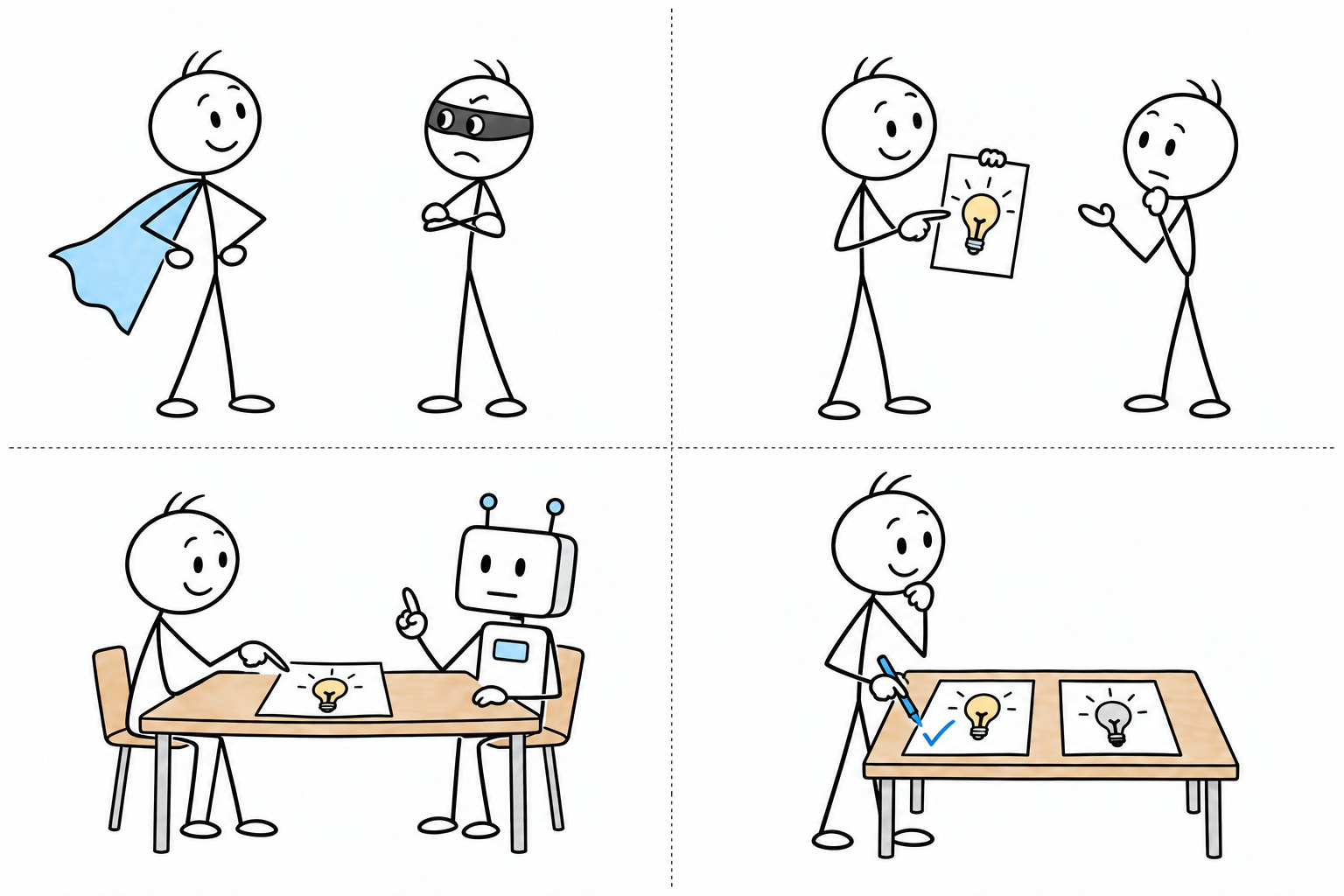
Superheroes are partially defined by the villains or arch enemies they face. Superman has Lex Luthor. Batman has the Joker. We often find the best villains are more than just characters who disagree with the superhero. Great arch enemies understand the hero’s strengths, recognize their weaknesses, and create challenges that often force a creative response.
We believe founders also need their own version of an arch enemy.
Building a startup requires an unusually high level of conviction. Founders have to believe an idea can work, often before there is any real supporting evidence. They also have to convince a range of people from employees, investors, and customers to believe in the same idea. Great founders are skilled at building this conviction. In the beginning, people may doubt the idea or challenge its assumptions, but over time belief starts to grow and more people become supportive. This type of support is valuable, but risks emerge when growing confidence makes the underlying assumptions less likely to be questioned.
Just when things seem to be going well for a superhero, an arch enemy often appears to challenge their beliefs and assumptions. Founders should consider having a similarly worthy opponent to challenge their own assumptions before those assumptions become the basis for a consequential decision. Being a good arch enemy takes effort. It requires building a strong, well-supported opposing argument that goes beyond just saying an idea might not work.
Argue The Other Side
Writing essays in graduate school provided a way for me to think through arguments and develop support for my ideas. One of the most memorable assignments required me to use the skills I was learning against myself. I submitted what I believed to be one of my better essays, the result of several weeks of research and work on a topic. A few weeks later, the professor stated he was adjusting the class schedule so we only needed to write one final essay. That final essay would argue the exact opposite of what we had previously written. The assignment required a full, compelling essay arguing the opposite perspective with the same level of research and support, rather than a simple objection to the original essay.
The assignment taught the difference between explaining why one position was wrong and genuinely understanding why someone could view another perspective as correct. We were essentially developing an arch enemy to our original idea.
Founders face a similar challenge. When we ask founders why someone might not adopt their product or service, or what might prevent the company from succeeding, our goal is to understand how they think through these opposing perspectives. Can they explain the evidence or reasoning that would lead someone to the opposite conclusion? A founder who understands the core beliefs and evidence behind an opposing argument is better positioned to identify real weaknesses in the business.
Build The Arch Enemy
Identifying and thinking through opposing perspectives is not always easy for a founder whose attention is focused on growing the business. An arch enemy takes the time to examine the weaknesses in the superhero’s plans. Founders can use a similar opposing voice to test assumptions they might otherwise overlook.
We are not suggesting every decision has to involve a counterargument before anything moves forward. The process is most useful when the opposing perspective is strong enough to make the team or founder reconsider an important assumption or decision.
A weak objection raised just for the sake of discussion adds little to the process. The goal should be to build a counterargument strong enough that it could change how a company operates.
Finding someone who can build a strong opposing case is not always easy. Doing this well requires someone with a deep understanding of the business and industry. Finding this person can be a lot to ask of a small startup team. It can also be uncomfortable if the person is an employee or team member, as challenging the ideas and perspectives of the team might put them in an uncomfortable position.
In these situations, AI could be a useful arch enemy. Explain the strategy, provide the supporting assumptions, and ask it to construct the strongest possible counterargument. A founder can question its reasoning, provide additional evidence, and ask it to challenge the revised approach. Among AI’s many helpful functions, one of the more useful ones could be examining in detail why a founder’s plans might not work.
Final Thoughts
Superheroes become great in part because their arch enemies continually challenge them. Founders can benefit from having their own arch enemy to push back on ideas, question decisions, and raise strong counterpoints.
We often hear founders talk about how AI helps them build and scale their companies. One of its most useful roles may be to act as an arch enemy, helping a founder consider the strongest case against the very plans it helped develop.
Success for a superhero often means defeating their arch enemy. For a founder, success could mean recognizing the arch enemy has a strong point worth considering. Finding a weakness early, while there is still time to address it, can be one of the most valuable advantages a startup has.
Wishing everyone a great weekend,
-Eric.