
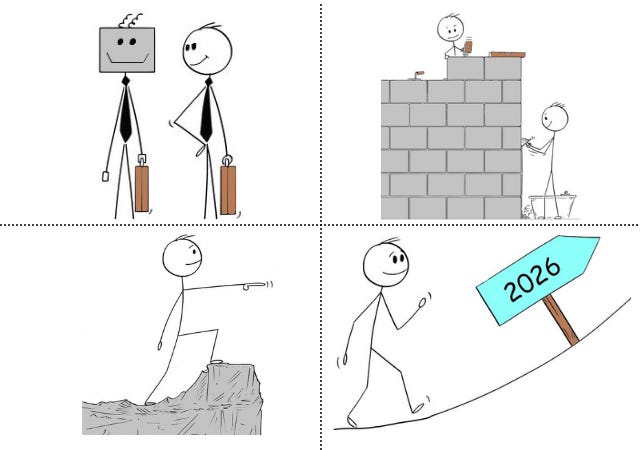
Happy 2026, 🎉
Most venture funds greet a new year by publishing predictions. Lists of what is likely to happen, which sectors may rise or fall, and which technologies will matter most over the next twelve months. There is comfort in forecasts. They give shape to uncertainty and allow us to feel prepared, even when very little has actually been revealed.
But prediction is not always the most useful place to begin a new year.
At moments like this, a more interesting question is not what will happen next, but why so much now feels possible. Why, for the first time in a long while, the act of starting seems less constrained than it once was. Why entrepreneurship, in particular, feels unusually accessible.
The Conditions Have Shifted
Over the past few years, the conditions for building have quietly shifted. Not all at once, and not always in obvious ways, but enough that the starting line now sits much closer than it used to.
Artificial intelligence is part of that shift. Founders today can test ideas, explore multiple directions, and iterate on solutions with a speed and efficiency that once required significant capital and large teams. What used to take months can now take days. What once demanded certainty now rewards curiosity. The cost of experimentation has fallen dramatically, and with it, the risk of launching a new idea.
At the same time, remote work has fundamentally expanded what it means to build a team. Geography no longer defines opportunity in the way it once did. The ability to partner with talented people around the world has become normal. A majority of company meetings now happen virtually, and even startup accelerator programs are often run fully remote. Small teams are able to assemble expertise that would have been unimaginable a decade ago. The advantage is no longer proximity to talent, but alignment around purpose and execution.
Compute power has also faded into the background. Infrastructure that once served as a bottleneck is now broadly accessible, removing yet another reason to wait. Ideas are no longer stalled by hardware limitations or prohibitive upfront costs. Many startups today can scale meaningful operations with little more than a laptop, reliable internet, and disciplined focus.
Even manufacturing, long viewed as slow and capital intensive, has changed. Prototyping, iteration, and production can now happen in near real time. The distance between imagination and reality has shortened as tools like 3D printing allow physical products to evolve with a speed that more closely resembles software development.
And perhaps most importantly, distribution has inverted. Social platforms and digital channels allow founders to share ideas, build credibility, and reach audiences at a scale that once required marketing budgets few early companies could afford. Today, clarity travels further than capital. A clear message, consistently shared, can reach millions almost overnight.
Why This Moment Matters
Taken together, these shifts create something rare. They create a moment where the barriers to starting are lower than they have been in a generation.
This does not mean building is easy. It still requires discipline, resilience, and patience. But the obstacles that once delayed action have softened. The limiting factor is no longer access to tools or resources. It is clarity of ideas, focus of effort, and consistency of execution.
The founders who will make progress this year will not be the ones with the most elaborate plans. They will be the ones who can identify a real customer pain point and explain it plainly. They will focus less on perfect products and more on meaningful problems. They will start conversations before launching campaigns and seek learning before scale.
Starting Small, Starting Real
One of the quiet advantages of this moment is that meaningful progress no longer requires grand gestures. It often begins with small, intentional steps taken early.
That might be a handful of structured customer conversations instead of a full product build. It may look like a simple prototype tested with real users rather than a polished launch. It may involve seeking out a few experienced advisors for short, focused discussions instead of assembling a formal board.
Capital can still be raised in similarly pragmatic ways. A clear narrative, a simple deck, reasonable expectations, and a thoughtful plan for learning often travel further than complexity or hype. Early pilots matter more than pronouncements, and early traction matters more than perfect storytelling.
In this environment, momentum is built through action, learning, and iteration.
Final Thoughts
Every year carries uncertainty. That will never change. What has changed is the cost of trying.
The tools now available to founders have removed many of the historical reasons to wait. Feedback loops are faster. Distribution is broader. The distance between idea and impact is shorter than it has ever been. This is not a call to predict the future or to rush toward the loudest opportunity. It is an invitation to recognize that the conditions for building are already here.
For those willing to focus on real problems, communicate clearly, and move with intention, this year does not need to be analyzed from the sidelines. It asks to be engaged.
Begin with a problem you understand deeply. Have the first conversation. Share an early version before it feels complete. Let the feedback loop guide what comes next.
This is a year that rewards those willing to start before they feel ready, to learn in public, and to keep moving forward as clarity is earned through action rather than assumed in advance.
If you have been waiting for permission, this is it. The clock has started, the field is open, and the only real mistake now is staying on the sidelines.
Wishing everyone a great first weekend of 2026,
-Eric.