
Happy Thursday, 👋
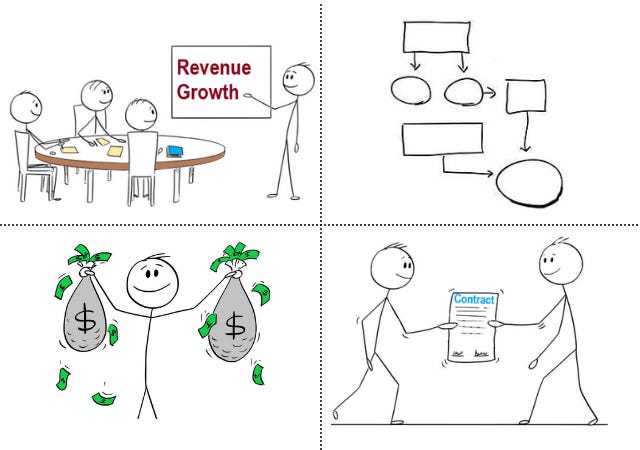
A founder walks into a meeting with a large company and says all the right things. We can help you grow revenue. We can improve customer experience. We can unlock new opportunities. The room is engaged as the product fits the company’s priorities.
Then the founder leaves, and the real conversation starts.
The question is no longer whether the idea could create value. It is how that value makes its way through the approval chain. Who owns the budget? Who signs off? How quickly can results be measured? What happens if the rollout underdelivers?
That is the shift many founders miss. In large organizations, great products do not lose only because the value proposition is weak. They lose because the path to approval is muddy.
That is why cost savings tends to be a much easier sales approach than value creation inside large companies. It is not because executives do not care about growth. they do. But cost savings are easier to assign, easier to model, easier to defend, and easier to explain when asking management to spend money on a young company.
Founders often respond to a stalled sales process by rewriting the value proposition. The better move is usually to help the customer navigate approval-market fit.
Cost Savings Has a Natural Home
The cost savings approach works well when selling to large companies because it fits neatly into the internal machinery of a large organization.
Cost savings usually have a defined owner. It can be tied to a budget line, a workflow, or a team performance metric that already exists. Reduce support tickets. Eliminate manual work. Lower vendor spend. Improve utilization. These are familiar ideas because they fit the way budgets and incentives are already organized.
That is what people around the table are often thinking about during a presentation, even if they never say it out loud. How do I sell this internally? Can finance measure it? Will procurement understand it? If the rollout is messy, can I still defend the decision?
Cost savings may not be the most exciting story a startup wants to tell. Startups want to talk about inflection points, new markets, and growth multiples. But inside a large company, the less glamorous story is often the one that moves faster. In enterprise sales, boring can be a feature.
Anything that appears to increase the budget also tends to invite executive pushback and the classic question: could we just build this ourselves? Cost savings approaches work differently because they already have a natural home inside the budget.
Large Companies Optimize for Defensibility
The hidden variable in enterprise buying is not always return on investment. Often it is career risk.
Inside a large company, the person championing a purchase is not only making a business case. They are making a reputational bet. If the initiative works, credit gets spread across the org chart. If it fails, the person who originally brought the idea tends to get the sole blame. That dynamic favors decisions that look prudent and defensible.
A cost savings initiative can be framed as operational discipline. Even if the results fall short, the logic still reads as responsible. We identified inefficiency, tested a solution, and expected a measurable payback.
Value creation is harder to package that way. Unlocking strategic upside, improving growth over time, or creating new opportunities across the business all sound worthwhile. But they also sound more speculative, especially when proof takes multiple quarters and the benefits are shared across teams.
That is why value creation is harder to underwrite. One team may pay, another may benefit, and a third may need to change how it works.
Approval-Market Fit Matters
Even founders who are building genuinely value creating ideas need to think about how to navigate approval-market fit.
Approval-market fit is the degree to which a product’s value can be clearly owned, measured, budgeted, and defended inside the customer organization. It is what allows a product or service to survive the internal process between a great meeting and a signed contract.
The best founders know how to narrow the first customer conversation. They lead with the part of the product that can be measured within the first 90 days. They make it easy for an internal champion to explain the purchase in plain language and set defensible metrics. Once the initial trust is earned and proven, then the conversation expands into a broader value creation story.
Look for ways your product or service can start as a cost savings initiative, even if the long-term vision is much larger. At the early stage, your customer is not just the company. It is the budget owner, the finance partner, procurement, and the employee who has to defend the decision to management.
Ask where historical approvals get stuck and what metrics matter most in the process. Those answers are a founder’s map toward contract approval. Enterprise sales are rarely just a persuasion exercise. They are an organizational navigation exercise.
The Real Trick Is Sequence
None of this discussion means startups should stop selling value creation or avoid ambitious outcomes. It means they should think carefully about sequencing.
Large customers often need to buy the obvious thing before they are willing to believe in the strategic thing. A large company may adopt a product because it saves time, then expand because it improves decision-making. It may start as an efficient tool and later become a platform. It may enter through one practical use case and grow into a much broader system that creates real value across the business.
The mistake is assuming that because the larger vision is true, it should also be the initial buying message. In enterprise sales, those are often two different decisions. One is about long-term value. The other is about near-term approval.
Founders who understand this distinction tend to move toward contracts. Founders who ignore it can end up in the familiar loop of enthusiastic meetings, pilot study purgatory, and follow-up calls that somehow never turn into a contract.
Final Thoughts
Large companies are not irrational buyers. They are organizational buyers, and organizations are built to reward decisions that are measurable, defensible, and easy to explain. That bias naturally favors cost savings over value creation, especially at the start of a sales process.
The lesson for founders is not to shrink the vision. It is to stage it. Sell what can be approved today so you earn the right to deliver what can transform the business tomorrow.
That is why approval-market fit matters. The first sale is rarely won on theoretical upside alone. It is won when someone inside the company can own the decision, justify the spend, and survive the meeting after the meeting where the real approval happens.
Founders often think their job is to give a great pitch. When selling to large corporations, that is only half the work. The other half is equipping an internal champion with a story that can survive the approval journey.
Wishing everyone a great weekend,
-Eric.