
Hi Everyone 👋
Welcome to the first edition of Margin Notes.
Our venture fund takes a top-down approach to investing. We start by identifying changing macroeconomic and technological themes, then work down to the inflection points they create. Those inflection points become one of the lenses we use to evaluate companies.
It is a process more common in public markets, where I began my investing career, but it works surprisingly well in venture. It helps reduce the shiny-object bias and re-anchor the conversation in fundamentals: why this market, why now, and what changed?
Margin Notes is where we open this process to our readers. We are not setting a strict cadence. These notes will be idea-driven: short reflections on themes sitting near the edge of our thinking. Some will be early, some incomplete, and some probably wrong.
The goal is not a fully formed thesis, but instead a place for exploration. If a note sparks a conversation, an introduction, a founder’s imagination, or a sharper disagreement, it is doing its job.
Let the adventure begin!
For most of human history, language has been one of the primary tools we use to organize thought. We observe the world, compress it into words, numbers, equations, diagrams, and models, then build from there. Scientific progress depends on this translation layer. It lets us reason together, preserve knowledge, and move ideas across generations.
But every translation layer has limits. Better language often leads to better thinking. Better categories. Better notation. Better theories. But what happens when an insight sits outside the concepts we already know how to express?
The Sapir-Whorf hypothesis, more commonly framed today as linguistic relativity, suggests that language can influence how we perceive, classify, and remember the world. The strongest version is language determines thought. A more useful approach is language shapes attention. Language at some level makes ideas easy to conceptualize while the limits of language can add boundaries to what we are able to describe.
There may be technologies or scientific relationships that are difficult to develop because our vocabulary, metaphors, and conceptual categories make the pattern hard to see.
This is where AI becomes interesting. GPT-style systems present themselves through language, but they do not process language the way humans do. Text is split into tokens. Then those tokens are transformed into learned numerical representations, processed through layers of attention and activation, then converted back into text. The model is shaped by language, but its internal representations do not map neatly to single words, sentences, or human concepts.
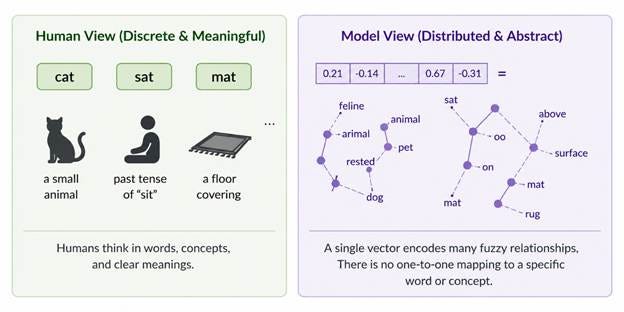
AI can detect statistical structure before we have a name for it. It can model relationships across enormous spaces of text, code, images, biology, chemistry, and behavior. For example, in protein structure prediction, models have shown that learned representations can produce useful scientific outputs in domains where the relationship between input and output is too complex for humans to manually encode.
This does not mean AI has escaped language entirely but instead AI gives us a new intermediary: a representation layer that can surface patterns first and ask humans to interpret them second.
If language has historically shaped how we organize and communicate knowledge, then some forms of insight may have remained hidden because our conceptual frameworks were incomplete. AI may help expose those areas. The human role shifts from generating every hypothesis upfront to designing the right systems, validating outputs, naming the patterns, and turning them into action.
Inflection Points
Representation-first discovery. Scientific and technical breakthroughs emerging from model identified patterns before humans can fully articulate the underlying theory.
Translation layers. Companies that convert machine-discovered patterns into human-understandable, actionable outputs.
Beyond text interfaces. Interaction models that move beyond prompts and responses into visual, probabilistic, spatial, simulation-based, and multimodal environments.
Human validation as leverage. Expertise shifts from knowing the answer to knowing how to test, interpret, and apply outputs that do not originate in familiar human categories.
The next wave of discovery may come from systems that help us see what our current language has been teaching us not to notice.
Thanks for reading,
-Eric.