

Judging the largest business plan competition allows us to meet several great companies in a short period of time. Business plan competitions can be like sporting events as teams advance over days of presentations and are constantly shifting and adjusting presentation styles based on feedback. While it can be intense, the rewards continue to grow as more corporate sponsors realize the benefits of supporting innovative companies.
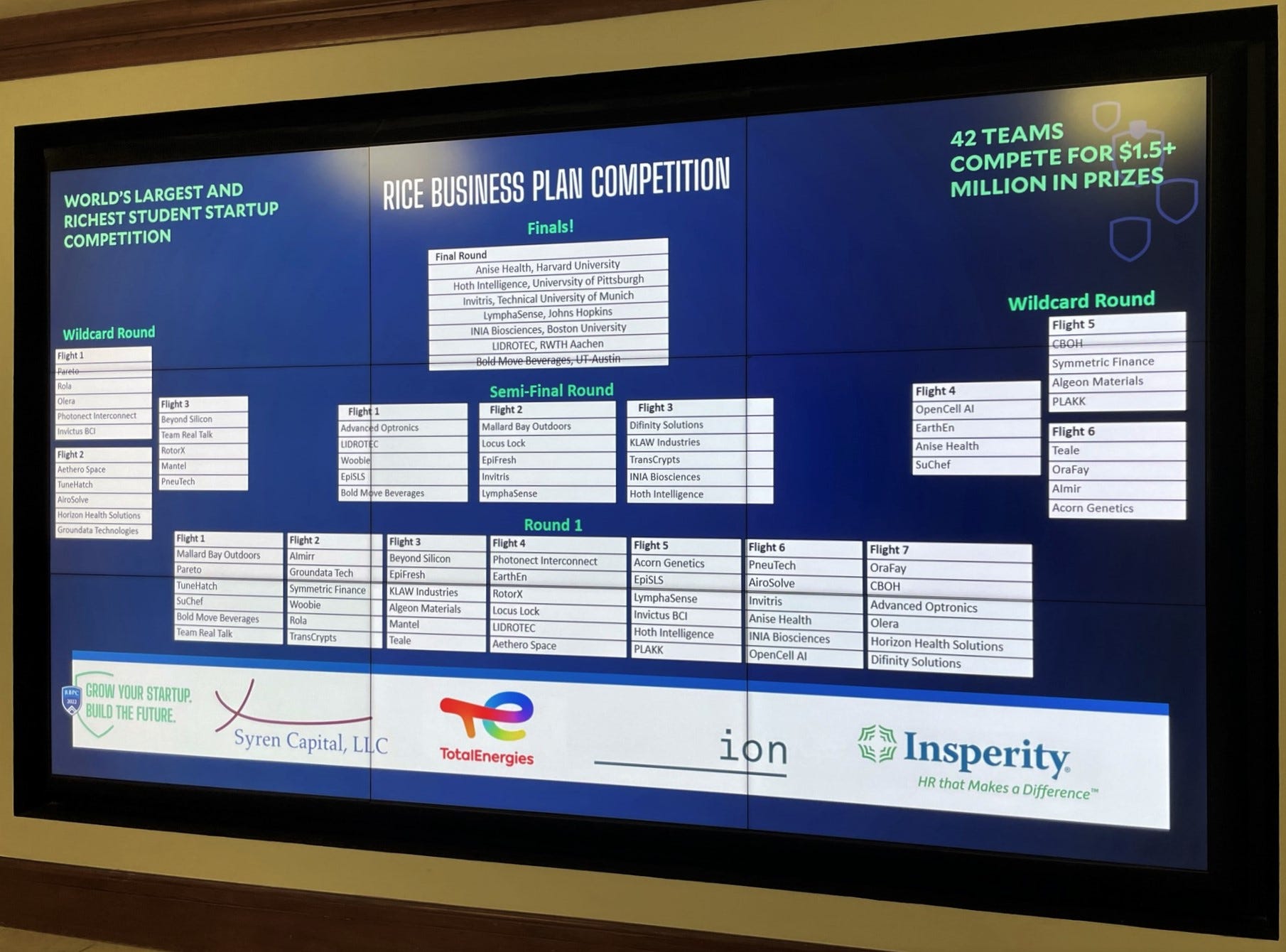
This past weekend we judged the Rice Business Plan competition. It is the largest student startup competition with 42 companies from 31 universities competing for almost $2 million in prizes. Each team is uncovering ways to push the boundaries of innovation within their respective industries or developing alternative approaches to help solve significant challenges.
Random Notes From The Competition
A benefit of judging the business plan competition is participating in multiple company presentations over a short timeframe. Below are a few general points we wrote down in our notes:
Sometimes its best to just tell the company story and not make it fit a certain mold. A few presentations felt as if companies were stretching to incorporate terms such as blockchain or web3 into the discussions when those were at best secondary to the solution. We understand the need to show a company incorporates leading technology, but Bold Move Beverages made it to the finals (and earned one of the investment prizes) with an idea of combining coffee and whiskey.
Several teams incorporated feedback and adjusted their presentations between judging rounds. Making changes in the middle of a business plan competition is impressive as it shows the companies listen, are able to quickly integrate feedback, and not afraid to try something different. For those wondering, yes the judges do notice as I heard several comment on how impressed they were companies listened to feedback.
The question and answer section of a pitch can be filled with uncertainty. Will the company get difficult questions and what if nobody asks a question? If an audience is slow to start asking questions, companies should consider mentioning questions they have been asked in the past as a way to spark the conversation. One team in particular did this and it prompted a good discussion.
Always include financial metrics as part of the main presentation. While it can help to have an appendix with detailed metrics, the main body of the presentation needs at least one slide discussing consumer acquisition costs, burn rates, or general financial estimates. Companies which did not include financial metrics during the initial presentation were almost always asked about them during the question and answer section. If you know investors will ask, put it in the presentation.
Most investors attempt to separate perception from reality, but even recent research at Harvard indicates while long term success is more dependent on actual skill sets, short term fundraising remains influenced by self-presentation. Raising capital is a difficult process so teams should be cognizant about making sure each meeting or presentation is approached with the same high level of energy and focus.
Who Won?
The leading team was LIDROTEC, which walked away with over $600,000 in prize money after making the trip from Germany to present. The company is developing an innovative solution for cutting microchips and reducing the number of damaged chips in the process without significantly increasing the manufacturing cost. We view this technology as a potential pivot point for microchip manufacturing as it improves manufacturing yield without significant changes to the overall process.
One that also impressed us was Hoth Intelligence, which received almost $400,000 in prizes from several groups. The Hoth team uses augmented reality to assist health care providers with visualizing patient anatomy in real time. Due to the length and uncertainty with the FDA approval process, we tend to remain skeptic of medical device companies as it can take years before revenue generation is achieved. Hoth realized it can start generating revenue today by selling its technology as an educational tool, allowing it to minimize the amount of funding required to bridge the FDA approval timeframe.
A majority of those in the finals were focused on the medical and biotech space. Despite the competition being in Houston, no energy or renewable companies made the final round. Over the next few weeks we are planning to reach out to several teams for further due diligence. As we make progress on the analysis, we will be providing updates on what we uncover.
Updates
With the start of the Major League Baseball season, we want to highlight an investment made last year. VKTRY develops and manufactures carbon fiber shoe insoles, allowing athletes to wear their favorite shoe and still receive a benefit from using carbon fiber insole. VKTRY managed to secure orders from several MLB teams, so we will be watching to see how much of a benefit players achieve this season. We plan to write several case studies regarding our investments to provide background on how we approach companies such as VKTRY. If anyone has used their products, let us know your thoughts as always curious to get direct feedback.
Please continue to share our updates with friends as we plan to add a few more features over the coming months.