

Happy Thursday,
Almost a year ago in July 2021 we started discussing venture capital investing and our experience advising companies big and small. The goal was to share a few ideas but we never expected our readership family would grow so quickly. Thank you to all those who have joined us over the past year!
We look forward to sharing more ideas and are working on a couple new projects we hope to announce this fall. Since we cannot talk about these projects yet, let’s instead talk about cash.
Failing Companies
Last year we had a conversation on Fraud. Our discussion involved the company HeadSpin and how its $1 billion valuation went to zero when the CEO and Founder was found to be falsifying invoices and bank records. Several large venture capital firms were investors in HeadSpin, making it a good example of how even the most successful funds can miss on due diligence.
Thankfully outright fraud remains rare in the venture capital space, but HeadSpin serves as an example of the impact of cash to a company’s future. An often repeated but true phrase is companies fail for a number of reasons but every company fails when it runs out of cash.
Cash Runway
Cash is the foundation of smaller companies and for those investing in Seed and Series A stages, an understanding of a company’s cash position should be one of the initial diligence items. Forecasting the number of months a cash balance will sustain the company is called its Cash Runway. The formula below reflects the current cash balance divided by the monthly expenses.
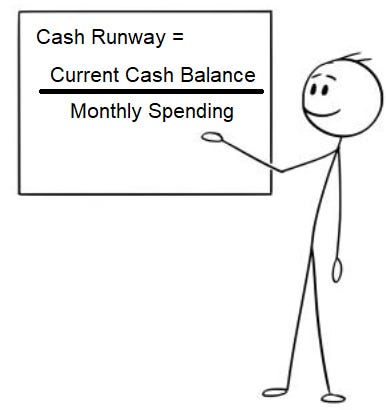
A few notes on evaluating the numerator and denominator.
Cash should reflect the cash in the bank. We have seen too many small companies fail to secure a new customer or additional financing fall apart at the last minute, so when calculating cash balances we only consider what is reflected on the bank balance.
Monthly Spend is also considered the company’s cash Burn Rate and consists of the actual cash spent. The number should be revised each month the Cash Runway is calculated to account for changes in spending or realized revenue.
Our discussion of cash was prompted by a recent conversation with a company raising its seed stage. After conducting an initial cash analysis, we realized the company spending had recently increased and it was set to run out of cash within two months. We hoped there was a mistake in our calculations but the team confirmed we were right and they just missed paying attention to the cash metrics until it was too late.
Cash Metrics
Conducting detailed financial analysis on start-ups is challenging due to a limited financial history or lack of complete financials. Every company has some level of cash and expenses, so regardless of the financial statements a cash runway analysis can provide a basic financial picture of the operations.
Including cash metrics as part of internal financial forecasts is a good exercise even if the company is not raising capital. The metric provides a financial timeline for the team to utilize when adjusting internal product launches or timing additional capital raises.
Exciting Updates
In May we wrote a case study about our investment in Spruce. A few days ago the company announced it closed its Series B financing. Congratulations to the team for raising $40 million in capital over several years and expanding the business to apartments across the country.
Thanks for reading and hope everyone has a great weekend.