
Happy Thursday, 👋
Companies of every size measure performance. Good companies find the right things to measure. Great companies know when it is time to change what they measure.
Performance metrics are often treated as neutral instruments. Numbers feel objective, dashboards feel authoritative. But key metrics are never passive. They shape behavior, influence decisions, and quietly signal what an organization truly values. Over time, the right metrics can pull a company forward, while the wrong ones can slow it down without anyone realizing why.
For founders and investors alike, one of the most overlooked questions is not what should we measure, but what should we stop measuring as the company evolves.
Strategic Evolution = Metric Evolution
Research indicates performance metrics must evolve as a company’s strategy and stage change. Early work by Kaplan and Norton emphasized that measurement systems should reflect both strategic intent and organizational lifecycle. A metric that is useful during a growth phase can become distracting, or even misleading, once a company matures.
More recent research into startup control systems reinforces this idea. Studies of venture-backed companies show that as organizations grow, teams naturally adopt more formal measurement and control mechanisms. This shift is not about adding bureaucracy. It is a response to rising complexity. Larger teams, more customers, higher revenue, and greater operational risk all require coordination, not just insight.
This is why dashboards matter. A well-designed dashboard gives leadership clarity into what truly drives the business. A static dashboard, conversely, is often a warning sign. It suggests the company has changed, but the way it measures success has not.
Ferrari Versus Rolls-Royce
Consider two very different cars: a Ferrari and a Rolls-Royce.

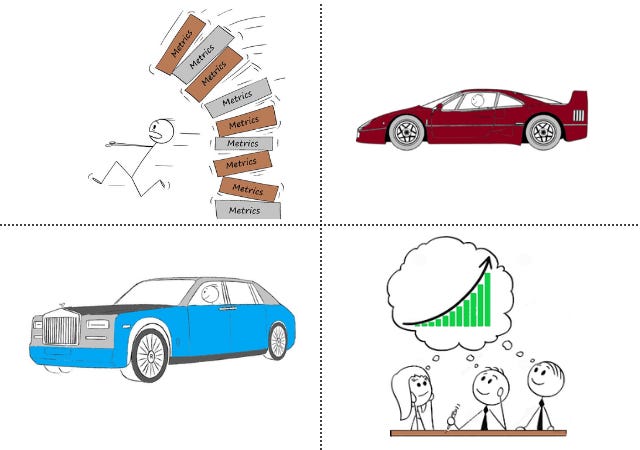
Imagine a startup as a Ferrari. The most prominent dial on the dashboard is not speed. It is engine RPM. The driver already knows they are moving fast. What matters is how hard the engine is being pushed, whether it is operating in the optimal range, and how close it is to failure. Early-stage companies operate in much the same way. The most valuable metrics are leading indicators. Cash burn, customer engagement, product velocity, and early traction. These metrics do not guarantee success, but they tell you whether the engine is alive and whether the company is evolving fast enough to survive.
As companies grow, many transition into something closer to a Rolls-Royce. The emphasis shifts. Stability, repeatability, and efficiency matter more than raw speed. The dashboard changes accordingly. Speed becomes more important than RPM, not because the company has slowed down, but because the goal has shifted from experimentation to consistency. At this stage, outcome-oriented metrics like retention, margin durability, unit economics, and cash conversion provide better guidance.
Two very different dashboards, each designed for a different vehicle and a different phase of the journey. Both provide clarity, but neither overwhelms the driver with unnecessary information.
Problems arise when companies insist on driving a Rolls-Royce while staring at a Ferrari dashboard.
The Danger of Metric Creep
As companies scale, a more subtle danger emerges: metric creep.
New metrics are added for good reasons. New teams, new processes, new risks. But old metrics are rarely removed. Over time, dashboards expand, reports grow thicker, and clarity erodes.
Metric creep creates two structural problems.
First, it enables selective justification. With enough metrics on the table, it becomes easy to find one that supports almost any narrative. Conflicting data provides cover for indecision or post-hoc rationalization. Metrics stop guiding decisions and start defending them.
Second, metrics become emotional. Leaders grow attached to certain measures because they understand them, built them, or have always been evaluated against them. What began as a tool slowly becomes part of identity, making it harder to question even when the metric no longer serves the business.
Large organizations are particularly vulnerable. Many produce extensive internal reports that have existed for years, generated faithfully, reviewed by few, and questioned by none. The process survives not because it is valuable, but because it always has.
From an investor’s perspective, this is a red flag. If leadership cannot clearly explain why each core metric exists, the metrics are running the company instead of the other way around.
Metrics Must Evolve
A practical way to think about metrics is to anchor them to the company’s current stage and primary goals.
Early stage: Is the product solving a real problem for a definable customer?
Growth stage: Can the solution be delivered repeatedly and economically?
Maturity stage: Can the business do this predictably, efficiently, and at scale?
Each question requires different signals. As companies move through predictable stages of growth, their structures, controls, and performance indicators must adapt or risk becoming misaligned with reality.
This is why we encourage companies to conduct an annual metrics review. Leadership should regularly ask:
Which metrics are essential for our current stage?
Which ones reflect a past version of the company?
Which ones exist only because no one has challenged them?
Often, removing a metric creates more clarity than adding a new one.
Final Thoughts
Metrics are not neutral. They tell a story about what matters, what gets rewarded, and how decisions are made. As companies grow, that story must evolve.
The goal is not to measure everything. It is to measure what helps the organization see reality clearly right now. Early companies need signals that accelerate learning. Later companies need indicators that reinforce discipline, durability, and focus.
The real discipline is not in building dashboards, but in knowing when to change them. when to simplify. when to let go.
As venture capital investors, we often say we back coachable teams. One of the clearest signs of that coachability is a company’s willingness to question whether the metrics that once defined success still belong on the dashboard today.
Great companies do not just grow. They grow up. And they change what they measure along the way.
Wishing everyone a great weekend,
-Eric.