
Happy Thursday, 👋
Investor pitch decks almost always include a section about hiring. It is usually one or two lines on the Use of Funds slide describing how capital from the current round will be spent. Most read something like: hire two engineers, one sales lead, and a customer support person.
Less common is a real discussion about how those people will be recruited, evaluated, onboarded, managed, and retained. Founders will spend thousands attending a conference to meet one customer, then try to fill one of the most important roles in the company with a free job post.
The reason hiring strategies are important for early-stage companies is because they have limited capital and time. The first hires build the foundation of a company’s culture. These are the people who shape how products are discussed, customers are treated, bad decisions are handled, and success is celebrated. Most importantly, they start to set the tone when the founder is not in the room.
The Default Choice
For many founders, the initial hiring strategy begins with their network. Former coworkers, friends, peers, classmates, advisors, and family connections are usually the first call. We understand this. It is normal human behavior to want to work with people you trust, especially in a startup setting where just about everything else is uncertain.
Hiring from a known network can be faster, reduce perceived risk, shorten the vetting process, and make early collaboration easier because there is already some shared history. Many great companies have been built by founding teams and early employees who knew each other before the company existed.
The mistake we often see is using familiarity as a substitute for a hiring strategy and early accountability. A former coworker can be the right hire when the role is clear, expectations are defined, and the person is being selected because they are excellent for the job. The same person becomes a risky hire when the job description is effectively “Are you open to joining a startup?”
Without a hiring strategy, the challenges of hiring based on familiarity start to show up slowly. Performance conversations are harder when the employee was recently a peer. Compensation conversations feel awkward when the person is a friend. Termination conversations can feel almost impossible. Those dynamics cause founders to delay necessary decisions when someone was hired based on a prior connection instead of a strategic process.
There is also a risk of sameness. Founders often know people with similar backgrounds, networks, and operating habits. Having this alignment can make early work feel easier because there is less friction. For startups, less friction can also hide a bigger problem, which is everyone moving in the same direction because nobody is asking if it is the right direction.
Startups need speed, but they also need judgment. They need people who can challenge assumptions, surface inconvenient facts, and bring perspectives the founder may not have raised.
The First Hires Become the Culture
Culture in an early-stage company often begins to form well before anyone thinks about defining it. In the early days, culture is built through what gets repeated, tolerated, rewarded, and promoted.
The first hires have an outsized influence on all four of these. They model the behaviors later employees copy. They show what urgency looks like, how much candor is acceptable, how customers should be treated, how decisions should be made, whether missed deadlines are explained or excused, and whether bad news is surfaced early or hidden.
The founder may set the tone, but the first employees make that tone operational. If the founder says the company is customer-obsessed, but the team treats customer feedback as an interruption, the culture becomes clear. If the founder says quality matters, but the team repeatedly ships careless work because everyone is tired, that also becomes part of how the company functions. Culture is not what the company says when it has time to explain itself. It is what the company does when it is under pressure.
Early employees also become visible representatives of the company. Customers, candidates, investors, and partners often experience the startup through them. A thoughtful first hire can make the company feel more mature than it is. A careless one can make it feel riskier than it should. In the early stages, the brand is the sum of every interaction someone has with the company, and many of those interactions will not be with the founder.
This is especially important because the first hires create precedents. A first sales hire who overpromises can train the company to borrow credibility from the future. A first product hire who protects quality can establish discipline before process exists. A first support hire who brings customer pain back into product conversations can turn service from a cost center into a learning system. None of this may be written down, but everyone notices.
Then the next wave of employees inherits those norms. New people look for cues. What happens when a customer is angry? What happens when a forecast is missed? What happens when the founder is wrong? What happens when no one is watching? The earliest employees help create the answers, which become the guidelines future employees follow. Slowly, the company culture develops, even if it is not the culture the founder had envisioned.
Hiring Is a Strategy Question
When an investor presentation gets to the Use of Funds slide, there is often a section showing how much capital will be allocated to hiring. The conversation usually focuses on the number of people and the functions they will fill. Two engineers. One sales leader. One customer support person. Then the presentation flips to the next slide with almost no further discussion.
As investors, this is the point where we start to ask more detailed questions about how the founder plans to find the right people for those positions, what those people are expected to contribute, and how progress will be measured after they arrive.
We are not implying every seed-stage company should build an internal HR department. Instead, we are looking for whether founders can outline a basic hiring strategy: how candidates will be found, what the high-level responsibilities are, and how key outcomes for those positions will be measured.
Most founders are great at discussing customer metrics such as acquisition strategies, conversion funnels, onboarding, and customer retention. Hiring is just as important, so it should have a similar level of planning.
In isolation, it could be argued that building a hiring strategy can become expensive. Good recruiting firms tend to charge 20% to 30% of a new hire’s first-year salary. That becomes an expense founders may feel is difficult to justify, which is one reason they often default to calling those in their network or using an online job posting. We are not suggesting companies hire top recruiters for every position. Instead, founders should focus on which roles are most important to get right at the beginning.
The economics of quality of hire are also important. McKinsey has highlighted research showing that high performers can be many times more productive than average performers, especially in complex or critical roles. Startup roles are complex by default. Early employees are asked to operate with ambiguity, make cross-functional decisions, build processes that do not exist, and solve problems without waiting for instructions. In that environment, a great hire can return multiples of their salary.
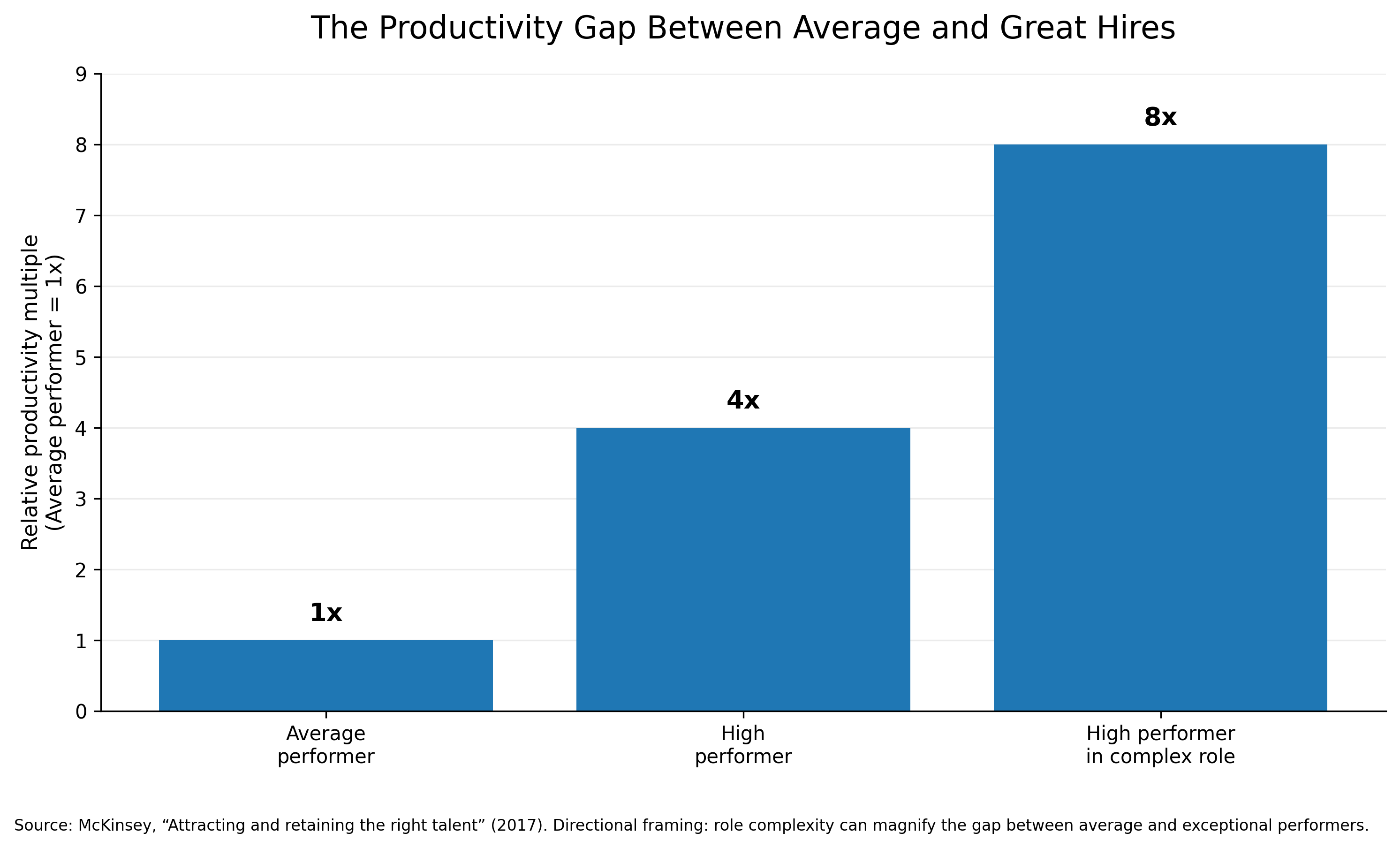
This is why hiring should have the same strategic approach as customer acquisition or building a pilot program. When a founder says that a large portion of the round will go toward building the team, that allocation should have a plan behind it. Salaries are investments in the people who turn those dollars into future company growth.
Final Thoughts
Early hiring is one of the first places where founder judgment becomes organizational reality. The people a founder chooses, and the standards used to choose them, tell future employees what matters even when nothing is put in writing.
A strong early employee can create multiples of their salary. They can help win customers, improve the product, recruit others, strengthen investor confidence, and raise the standard for everyone around them. A weak early employee can do the opposite slowly enough that the damage is hard to see until it has compounded.
Every fundraising slide that shows capital being allocated to building the team should also answer why those roles matter, how the right people will be found, what standards will be used to evaluate them, and how the company will know whether the hire is working. A pilot program usually has a thesis, a budget, and success metrics. Hiring the first team deserves the same discipline, especially when it may be the largest use of capital in a funding round.
The first hires show the company what urgency looks like, how customers are treated, how disagreements are handled, and what level of work becomes normal. In an early-stage company, the initial team does not just help build the culture. It becomes the foundation the company grows from.
Wishing everyone a great weekend,
-Eric.