
Happy Thursday, 👋
Over the past few months we have worked with several companies encountering challenges due to the uncertain economic environment. Lost clients or unexpected cost increases can be devastating for smaller companies. Often a specific failure itself may not cause the greatest challenge but instead our relationship and perception of failures are what leads to devastation.
Most management books tell us the first steps we need to take after a failure is outlining what happened and evaluating areas the process can be improved. If a prototype falls apart during a demonstration or a client decides not to sign a contract, it helps to understand the why behind these actions. We agree with this approach but suggest teams consider reviewing an often overlooked silent roadblock as the first step in failure recovery.
Unspoken Feedback
Each day we speak on average 16,000 words, but a study using brain imaging estimates we also have 6,000 non-verbal thoughts each day. An average sentence length is 15-20 words, suggesting our brains might process almost five times as many unspoken words each day. Most of the conversations within our brain consist of evaluations and judgments as our mind is constantly trying to anticipate and solve problems to keep us safe.
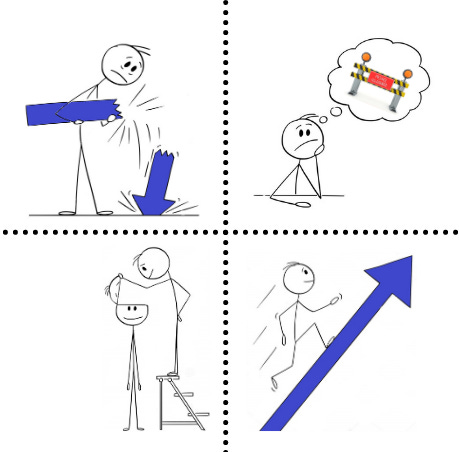
When we fail at a task or project, our mind jumps into action and views failure as a danger so feeds us a series of non-verbal thoughts to steer us away from repeating the same task and failing again. Almost without delay our mind starts conveying ideas such as “I am just not good at that” or “Maybe I should try a different career”. Verbal labeling and discussion of these immediate non-verbal reactions echoing across our brains should be the first step a team takes after failure.
Label The Silence
When a team initially realizes a failure, the room often goes silent as everyone’s attention is drawn inward as our minds immediately start replaying how we contributed to the failure, why we should not try again, and reasons our best option is to just give up.
Watch the locker rooms of professional sports teams, those who just lost a big game are almost always silent. It is our mind protecting us from danger with suggestions of quitting supported with a replay of each missed play or failure to close the sale in a client meeting.
These first few minutes after a failure are when leaders can be most impactful by verbalizing what the team is internalizing as their minds race to protect them from future disappointment. Label the natural reaction as a positive indication of our subconscious desire to win. Our mind realizes we may try again but is doing its best to convince us against that idea.
Describing to your team what is happening and why will start the recovery process from a failure. Accept the mind’s self-talk as its way of protecting us and label it as a natural reaction. Guide the team through recognizing these unspoken roadblocks and the importance of labeling them before starting to rebuild a strategy for overcoming a failure.
Time to ACT
Acceptance and Commitment Therapy (ACT) is a form of psychotherapy designed to guide the recognition of our natural reaction to events and help us overcome setbacks. The basis of ACT is to accept our mind’s negative thoughts as a natural failure response and label them as an internal security mechanism.
Our mind’s protection reaction is good at keeping us safe but bad at differentiating the situation. If we grab a pot of boiling water, our mind tells us to never again grab a pot of boiling water. The same response occurs when we lose a client as our mind jumps into protection mode and quickly suggests we should never try and sell another product. We need to take the proactive step of labeling our mind’s reaction to certain types of failures, such as a lost client, so we can overcome these nonverbal roadblocks.
Before launching a project or visiting new clients, take a few minutes to walk the team through the natural reaction of our minds jumping into protection mode if we fail. As leaders the goal is to reduce the devastating impact on a team from failure by acknowledging the nonverbal responses our minds use to keep us safe. A team becomes more powerful when each member understands and labels the mind’s nonverbal feedback before starting the process of understanding why the failure occurred.
Different Perspectives
A lot of us may use the ACT techniques without recognizing them. Imagine a team member just spent weeks working with a potential client only to have them sign a contract with a competitor. To be supportive we might say “It happens to everyone” or “We cannot win every client”.
Now consider the reverse situation. It was your time and effort chasing a client to only have them make a devastating last-minute decision. Within seconds of hearing the news your thoughts turn to “I must not be good at this” or “Maybe I should look for another career”.
Changing the way we view the situation allows us to recognize how our minds take a different approach to the situation. Recognizing and labeling what happens when we encounter failure is a powerful tool for helping teams overcome nonverbal roadblocks and become stronger at reducing the impact of a failure.
Additional Thoughts
When we conduct investment due diligence, we look for teams capable of embracing failure as an opportunity for improvement. Sometimes new teams may struggle with differentiating between embracing failure and risk taking, making it important for team leaders to remain aware of the culture they are building. Also be careful of developing a culture where learning only happens as a result of failures, as evaluating successful outcomes offers an alternative perspective to understand a team’s strategy or internal process.
Let us know how we can help further shape these discussions within your team as our goal is to advise and invest in dynamic organizations.
Wishing everyone a great weekend,
-The Caymont Ventures Team.