
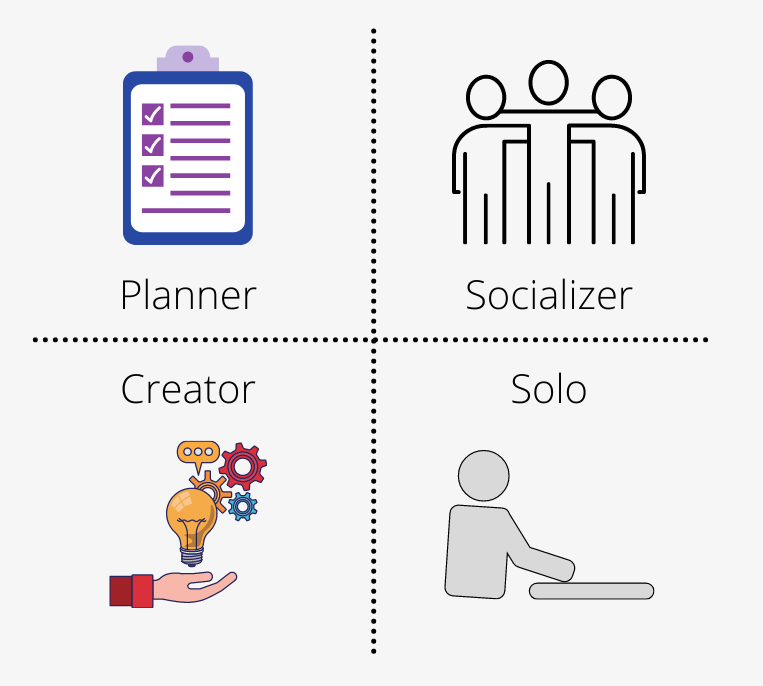
Company founders and executives are critical for defining corporate culture and strategy. Over several years of start-up investing and performing advisory work, we developed four broad categories reflective of founder characteristics. Each is unique and beneficial at different stages of a company, so understanding each helps us maintain an objective perspective.
A few consistencies tend to emerge as we evaluate companies or investments. Founder or executive personalities are near the top of the list, specifically the approach to managing the business or solving problems. Company growth may be driven by market forces, but it is sustained due to management and strategy, so building the right mix of personalities is key to surviving the volatility inherent with launching new ventures. Everyone is individually unique so there are no right or wrong categories, instead these allow us to define the best approach when evaluating or advising a company.
Planner
Building a solid corporate strategy or plan provides the corporate foundation from which growth is obtained and measured. Someone high on the planner scale brings well defined strategies including establishing timelines, Gantt charts or key performance indicators. Founders who are strong planners tend to be transitioning from larger companies where they are experienced with building detailed strategies and coordinating across multiple teams so may struggle initially to find the balance between decision speed and design.
Socializer
Networking can be an important and cost-effective way to raise capital or market a product, as the right connections may create a significant inflection point for a company. The start-up community has grown to a point where conferences or events occur almost weekly. Balancing attendance while maintaining a focus on building a company can be challenging even for the most organized people. First-time founders are more likely to seek external validation by filling their schedules with conferences or coffee events before discovering the right balance of an internal and external focus around their business.
Creator
Finding the solution to a problem is how most successful businesses start. Some founders are great at solving these challenges while others may spend years perfecting a single solution. The characteristics which drive the development of new ideas or an intense focus on perfecting a product are important but may hinder overall business growth. The creator category tends to favor engineers who are driven by a desire to solve problems and develop unique solutions which build the foundation for great companies.
Solo
The solo entrepreneur developing an idea is a typical start-up story. Those capable of managing all aspects of a business themselves may succeed during the early stages but confront challenges as the company grows. Delegation can be difficult after a founder dedicates months or years nurturing an idea but growth is not possible without trusting others to become part of the team. The solo category captures a wide range of backgrounds but tends to be more prominent in those with limited business or management experience and look for help balancing an expanding team.
The Ideal Team
The above categories reflect common trends encountered after years of working with start-up teams. Each characteristic plays a roll in growing a company and is important at different stages of the corporate lifecycle. Start-up investors are more involved with management teams, so understanding the four categories provides a basis for helping teams solve problems and achieve growth targets.