

Happy Thursday, 👋
Beginning a new year provides a chance to reset and refresh future plans. A powerful method for maintaining focus over the next twelve months involves setting team and individual goals. Goals can align efforts and motivate teams but also present ethical and managerial challenges, increasing the importance of developing procedures for identifying and tracking overall progress.
Goals and Skills
Defining and achieving goals involves exploring new challenges and pushing the boundaries of our abilities, often requiring development of new skills or refining existing procedures. Consider a plan to increase sales by an additional $10 million for the year, which may require enhancing product development skills, improving sales techniques, or refining leadership abilities. Focusing on the skills underlying a goal can often result in greater success over time. Goals achieved out of pure determination may appear to be successful outcomes, but without the foundational knowledge or skill improvements, sustaining performance over time becomes difficult.
Goals Behind The Goals
Maybe a goal is to build and sell a company, but then what? Goals are powerful motivators, but the why behind a goal also needs to be defined. Once the celebration of a successful goal fades, the arrival fallacy sets in as our schedule becomes quiet and we realize our thoughts are no longer consumed by a focus on specific achievements.
The period of feeling successful after achieving a goal is often shorter than most expect. We have met many founders who spend years focused on building and selling their companies, only to become lost and depressed months later. Achieving the goal of a successful exit had become their goal, but there was nothing behind the goal. As goals are defined, the why should become part of the process so the finish line instead becomes a transition line.
Building Meaningful Goals
There are over 50,000 books on Amazon providing advice on goal setting so we are not going to add another idea to the list. Instead an approach proposed over 40 years ago remains relevant today. The SMART method is one of the classical structures for defining goals based on the following acronym:
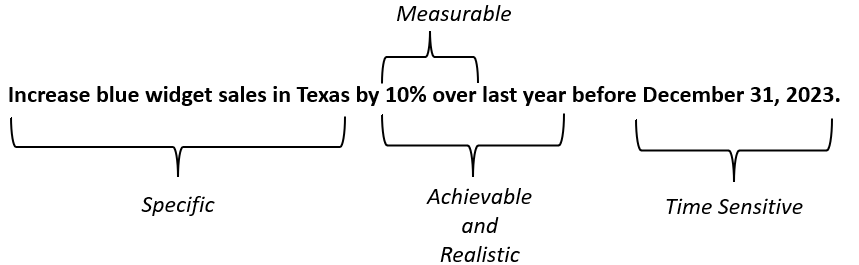
Specific – target a specific area for improvement, which allows measurement of progress toward the goal.
Measurable – metric or indicator which becomes the unit of measurement to define achievement.
Assignable (or Achievable / Attainable) – originally used to help leaders specify who would be responsible for a goal, but over time has been modified to reflect Achievability or Attainability for choosing realistic goals.
Realistic (or Relevant) – realistic goals should be achievable using available resources. Revised wording uses Relevant for understanding if a goal is applicable to the person or company trying to achieve it.
Time Related – indicate when the results are expected to be achieved.
Below is an example of how the SMART concept guides construction of a goal:
Goals Bring Their Own Challenges
Discounting the emotional aspect of goals can result in unexpected outcomes. Goals have the power to motivate teams or individuals during setbacks or challenges but the same level of emotional motivation may result in empowering unethical behavior.
A study where participants were provided a mix of goals, rewards, or encouragement found those with goals or rewards often overstated their productivity. The below chart details the differences in overstatements between three groups: those told to just to their best, those given a goal, and those with a goal plus a financial reward. The top line shows the dramatic increase in overstatements for those assigned either a goal or a goal with a reward, demonstrating the inherent risks of goal setting.
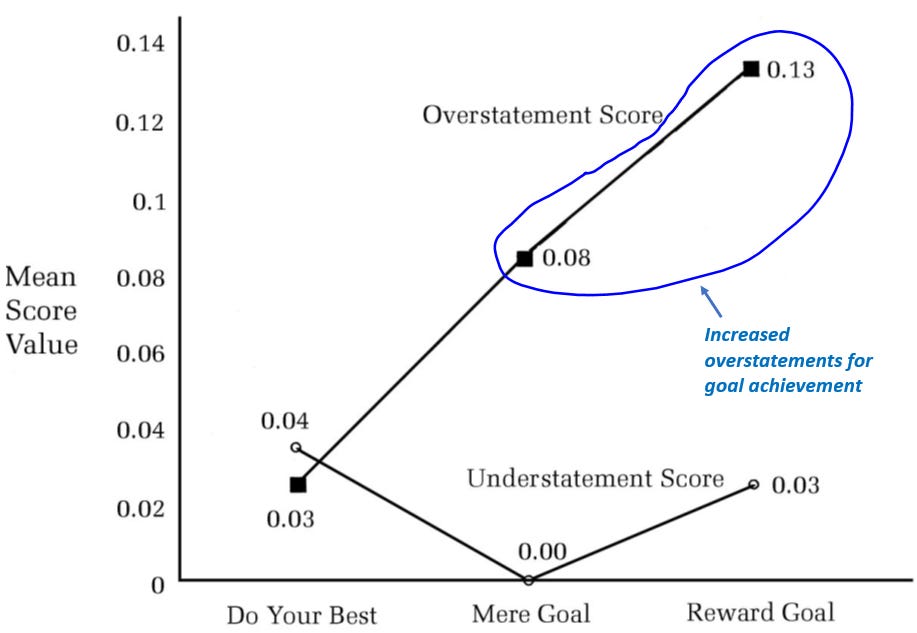
The same study also found those overstating productivity were more likely to justify taking additional unearned rewards. The emotional impact of goals can become a vicious cycle of overstating results leading to self-justification for additional unearned compensation.
Developing a cadence for monitoring and updating progress helps mitigate the inherent challenges of goals and potential for unethical behavior.
Unforeseen events can and will impact achieving goals. Documenting these provides a team the ability to adjust goals mid-year or discount those which become unachievable. Ongoing progress monitoring also helps indicate if a goal is becoming unreasonable or unachievable and mitigates the potential for unethical behavior to achieve otherwise unattainable outcomes.
Declines in product quality or increased customer returns and complaints can also be a warning sign the team is pushing too hard or focused on a specific achievement while discounting other areas of the company.
Financial details can uncover signs of potential unethical behavior in goal achievement as shifting revenue, delaying vendor payments, or unexpected inventory changes are signs to ask additional questions.
Plans For 2023
As we look forward to 2023, some of our goals include becoming more active in sharing ideas with our family of readers and expanding our advisory business to reach more companies. We are also planning a new venture fund for later this year to continue our focus of methodically allocating capital for Seed through Series A investments into dynamic teams.
Wishing everyone a great weekend.
-The Caymont Team.