
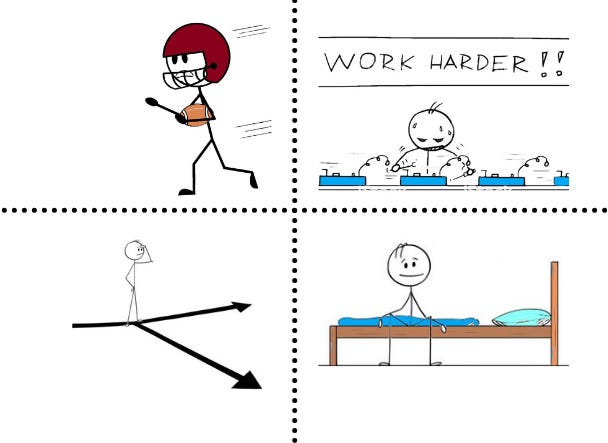
Happy Thursday, 👋
During the past few months we have engaged with numerous companies indicating their team consisted of high performers. However, when probed about their criteria for a "high performer," the prevalent response seemed to revolve around a focus on "winning." The definition of winning varies significantly, especially for startups where it often corresponds to attaining a $1 billion valuation. This raises an intriguing question: can someone be considered a high performer even if the company they are a part of never reaches the conventional benchmarks of success?
The world of professional sports is where we often see references to the phrase “high performer”. Take for instance, NFL quarterback Dan Marino, who held the record for the most career touchdowns for eight years, or Charles Barkley in the NBA who was an 11-time all-star throughout his 16-year tenure. Then there's baseball icon Ty Cobb, who, despite retiring back in 1928, still holds the record for the highest career batting average.
None of these athletes won a major championship, but they are celebrated as high performers. Perhaps, then, being a high performer isn't solely about winning, but instead about persistently improving and revising one's skills in addition to supporting and helping other team members.
Incremental Steps
Cultivating a team of high performers involves a systematic approach where individuals analyze their actions, identifying potential areas for steady improvements. Just as a baseball player examines each element of hitting a ball, the journey to enhancing performance begins with understanding each component of a larger task.
Equally important is the evaluation of these improvements, as modifying certain actions can sometimes lead to diminished overall performance. It's not uncommon to witness teams overwhelming their schedules with meetings when trying to expedite a project, only to discover the increased interruptions are hampering progress. Occasionally, streamlining processes by eliminating unnecessary steps is the key to unlocking enhanced performance.
Shifting Habits
Nearly half of our daily activities are dictated by habits, which are often difficult to change without a well-devised plan or system for assessment and adaptation. While coaches in the sports world resort to video replays to help players adopt new skills, corporate leaders must foster a culture of constructive feedback. This approach aids team members in sustaining changes and provides a process for openly discussing areas for change or improvement.
Modifying a process is often easier with the presence of a helpful colleague to enforce accountability as they act as the video replay to prevent us from falling back into hold habits. A challenge we often see is founders or leaders struggling to find those who can hold them accountable given the political dynamics. In the past we asked the question “who tells you no?” which serves as a way to reflect on building a proactive advisory board for the leadership team regardless of company size.
Making The Bed
A few years ago Admiral McRaven made a speech suggesting changing the world begins with the simple act of making your bed each morning. This notion underscores the power of initiating your day with a small yet successful endeavor, a tangible change that's also straightforward to measure. McRaven emphasized that mastering small tasks paves the way for achieving grander goals.
High performers adhere to a similar philosophy, perpetually seeking small tweaks within a broader process that culminates in significant success. It is a rare to witness a professional athlete overhaul their strategy entirely; instead, they thrive on continuous learning and incremental process improvements.
Additional Thoughts
The evolution of a high performing team hinges on individuals excelling in their respective roles, with a collective aim of fostering continual personal growth. Establishing a culture that champions constructive feedback can be a powerful tool in overcoming the inertia of old habits, and serving as an effective substitute for a video replay.
As teams sharpen their focus on fostering a high performance culture, leaders must navigate the delicate balance of managing both internal and external expectations regarding achievable goals. Despite relentless efforts to improve, it's essential to acknowledge that not every day will bring success. Even the best athletes may not win a championship, yet their unwavering commitment to improvement throughout their careers is testament to their high performance nature.
Wishing everyone an enjoyable weekend,
-The Caymont Ventures Team.