
Understanding the basics of financial metrics is important for company management and investors. Too often we tend to hear financial metrics presented by companies without much understanding of what they are presenting. It is always better to ask for outside help of a financial consultant when compiling presentations or creating metrics as slight missteps can cause investors to quickly lose interest.
After months of design and development work, the first email arrives with an order for one of your company’s newly designed dog toys. The first sale is always a reason to celebrate for any startup, so you send out an email to your group of potential investors announcing the good news. Within an hour you receive a response. Instead of a congratulations, the investor is asking for your CAC.
What’s A CAC?
Customer Acquisition Costs or CAC measures all the expenses for a business to acquire its customers. The CAC is not a bill you pay the marketing company but instead a reflection of the total costs of marketing, sales, overhead, and other expenses involved in promoting a product. CAC includes all these costs spent to convince a customer to buy a product, but should not include the day-to-day costs to operate the company. Calculating CAC can vary depending on the company and customers, so it is always a good idea to be ready for a discussion of the components involved in the calculation when discussing CAC with investors.
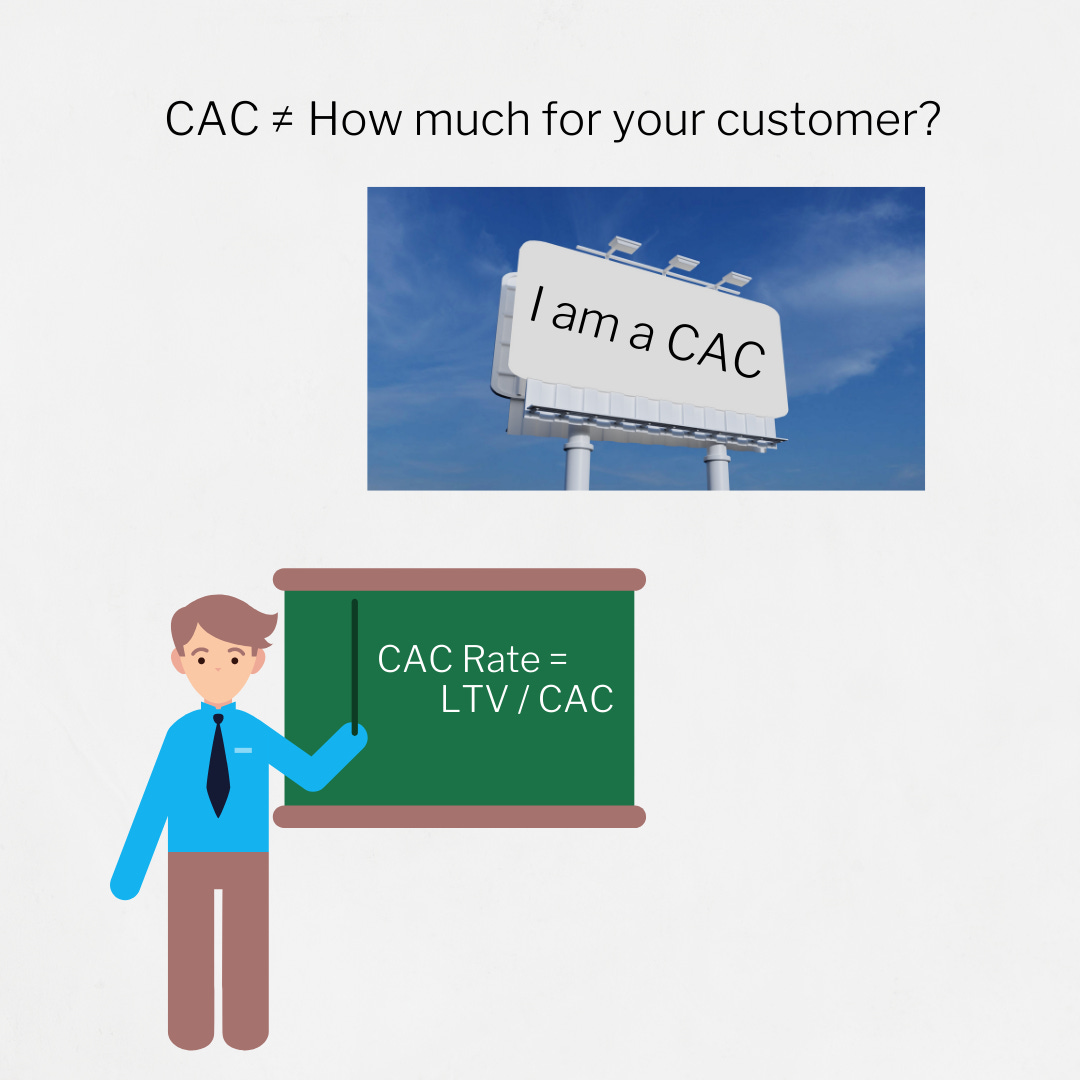
Another term associated with CAC is the Lifetime Value of the Customer (LTV). The LTV is the amount of money a customer will generate over time, which is usually more common for longer term contracts or repeat purchases. Dividing the LTV by the CAC results in the CAC Rate (LTV / CAC), which is the multiple of money earned based on the cost incurred.
CAC Metrics
The CAC Rate should be about 3.0x for most companies. This rate implies a return to the company for each customer of three times the cost involved in convincing the customer to buy a product.
A multiple of 1.0x indicates a loss with each customer since the customer is only covering marketing costs but not additional costs for a company to remain in business. Anything less than 1.0x and the company is losing money on marketing spend and business overhead. An important disclaimer is start-ups may operate below 1.0x during the initial marketing of a product, as the first few customers will be the most expensive, but ideally there should be a quick improvement in the CAC Rate as customer counts grows.
But Our Start-up Has a Zero CAC?!?
If you have customers, the CAC should not be zero. When a company claims it has zero customer acquisition costs (yes, we hear this more than expected) it signals the company does not understand its financial metrics. Unless customers magically appear, there should always be some cost associated with generating customers.
· If you have a website discussing your services, you have a CAC.
· If you visit potential customers, you have a CAC.
· If you create company swag or marketing materials, you have a CAC.
· If you attend trade shows or conferences, you have a CAC.
The CAC is an important metric as it helps management identify problems with marketing or customer turnover. It also allows investors to understand the trajectory of a company and potential to reach self-sustaining cash flow. Monitoring the CAC is key for any company with customers, and remember it is only the very rare (we have yet to find one) companies which have customers but no CAC.