
Happy Thursday, 👋
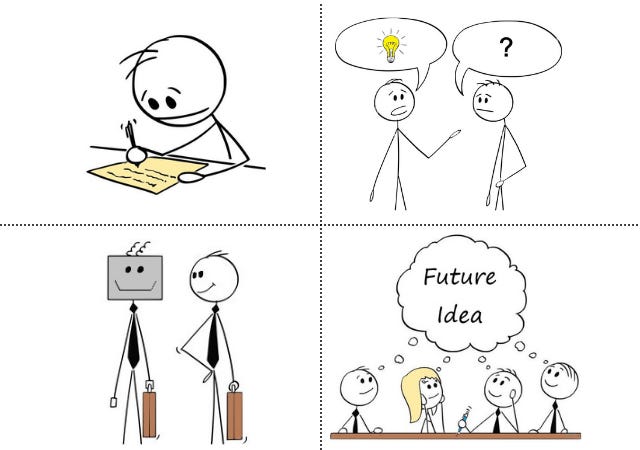
In grad school, the assignment for our mid-term appeared straightforward. We were asked to pick a topic and write a strong opinionated argument either for or against the idea. Then for our final exam we had to write the same paper but using the opposing argument. Our grade on the final depended on whether we could be just as convincing as we were in writing the original.
Although it sounded like an exercise in debate, it ended up being an exercise in vocabulary and perspective. Writing the opposite view demanded new words, a new frame of reference, and a different mental model even though the topic had not changed. It was less a test of argumentation and more an exercise in learning to think with an entirely different perspective.
That assignment revealed a challenge founders and investors often encounter. Our words set the boundaries of our imagination. If we cannot describe a new idea using the vocabulary we currently have, we will struggle to understand it. Without that understanding, the idea will not be built, customers will not buy, and investors will not invest.
Yesterday’s Language
Founders run into this language problem constantly. They may have a novel idea and try to describe a future vision, yet they are stuck with the familiar language of past technologies. Even if they assemble examples from current products, the explanation often fails to convey what they are actually building. Investors and customers struggle because the old language does not reflect the new reality. The result is a pitch that sounds familiar rather than transformative.
Founders may be presenting entirely new concepts or technology, but the vocabulary they rely on is anchored to the past. Using old analogies to describe new ideas becomes a form of reinvention rather than innovation. It is like going back to the early 1990’s and describing email as a faster postal service. It may be technically accurate, but it misses the entire point of how email reshaped entire industries.
The founders who break through this barrier do something surprisingly simple. They name the future. They introduce vocabulary that helps the rest of us understand what they are building. Sometimes they do this intentionally. Sometimes the world simply adopts the words they use.
Every major technology wave began with a shift in language. Cloud, blockchain, machine learning, cell phone, quantum computing, streaming. Each term changed how we thought about technology and opened the door for entirely new categories. A new word becomes a new lens. A new lens becomes a new market.
Innovation Starts With a New Description
Innovation often follows a predictable pattern. The name or idea appears first, and the industry eventually grows into it. Science Fiction has long served as a testing ground for new technological language. The concept of a robot was coined years before actual robots existed, Dick Tracy popularized the idea of a smartwatch, and rocket launches were described in the 1600’s. The Technovelgy Timeline of Science Fiction is a fascinating resource for reviewing how fictional vocabulary often precedes real-world innovation.
Language and concepts emerge first, then technology catches up. Founders may have the technical insight and vision, yet still struggle if they lack the vocabulary to translate the idea into a form others can understand. Naming the future is often the first step in building it.
Investors Face the Same Challenge
Investors encounter the same limitation. The most transformative companies rarely match the vocabulary of the prior decade. These ideas sound unfamiliar at first, resist clean labels, and do not fit neatly within predefined categories.
In venture investing, the willingness to explore the unnamed may be one of the highest forms of conviction. The next great company rarely fits the language of the past and recognizing this is often the difference between seeing what is emerging and dismissing what is unfamiliar.
Final Thoughts
Writing the opposite perspective for an argument forces us to change our vocabulary and in doing so unlocks new ways of thinking. Founders face the same challenge as they attempt to clarify obscure ideas. If they describe their company only through yesterday’s vocabulary, they risk building yesterday’s company.
Investors face a similar trap when evaluating ideas through outdated mental models and language. Industry inflection points occur when a word or concept emerges that does not yet fit the current dictionary but accurately captures where the world is heading.
Ask someone 100 years ago to define the cloud, streaming, windows, or a bug and you would hear a completely different meaning than today. The language of technology reshapes how we understand the world. Sometimes we repurpose old words for new ideas. Other times we invent entirely new words like smartphone, internet, app, or software because the world needs new vocabulary to make new ideas possible.
Progress may be less about discovering new ideas and more about learning to describe them. New words and new perspectives unlock new markets and new thinking. Founders who learn to name what others cannot yet see are the ones who end up building the companies others never thought possible.
Wishing everyone a great weekend,
-Eric.