

Happy Thursday, 👋
When we attend founder or networking events, we often hear the question, “What are you building?” It is almost a default opening from investors or potential customers, intended to give a founder a few minutes to talk about their company. The challenge is founders frequently interpret the question literally and immediately launch into a detailed description of the technology or product.
Suddenly, someone who may be a generalist or from outside the industry is hearing about algorithms, technical specifications, coding, or some particularly impressive piece of intellectual property. These may all be important aspects of the company, but a five-minute conversation at a networking event is rarely the right place to begin a deep technical discussion. More than once, we have heard investors or potential customers walk away from one of these conversations saying they still have no idea what the company actually does because the founder spent time in the technical weeds without providing a broader context.
Because of this, we have started asking a different question: “tell us about the problem you are solving.”
It is a subtle change that helps reshapes the conversation. Instead of starting with what the company is building, the question directs the discussion toward understanding the problem. What is the specific challenge, who is struggling with it, and why existing approaches are not working.
Once we understand the problem, the natural follow-up question becomes, “how are you solving it?”
At that point everyone in the conversation should have a general idea of why the specific startup exists. Everyone understands the problem so now are curious to hear the solution.
Products are Downstream from Problems
Every startup product exists because someone believed there was a problem worth solving. If we visualize the startup as a flowchart, the product would sit downstream from the problem. From a basic process perspective, there cannot be a meaningful solution until there is first a problem worth solving.
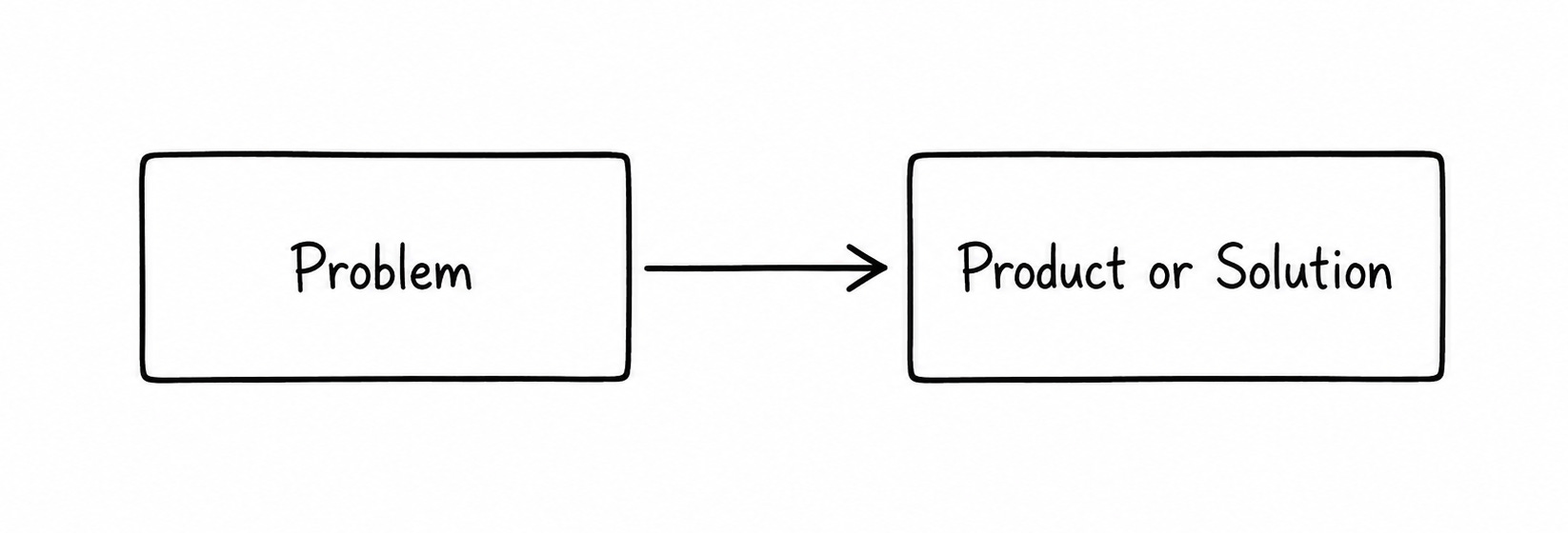
Thinking about startups this way has an important implication for founders. If the company is being built around solving a particular problem, the founder should be among the people most knowledgeable about the problem.
That knowledge should go beyond recognizing the problem exists. A founder should understand how customers deal with it today, why the current process developed the way it did, where the greatest pain exists, and what the problem costs in time, money, risk, or lost opportunity. They should also understand what has been tried before and why those attempts succeeded or failed.
Timing is also part of that understanding. We have written previously about a question we ask during diligence: why now? What changed in technology, regulation, customer behavior, or another part of the market that makes a different solution possible today? Understanding the problem also means understanding why now may be the ideal time to develop a new solution.
As investors, we also enjoy hearing about the deep technical work a team is doing and the new concepts being attempted. Those details can become important parts of a longer discussion, but the underlying reason for building the company should remain understandable. The solution might be highly technical or complex, but the problem should be something a founder can describe in broad terms.
Teach The Problem
One of the strongest signals we look for in founder conversations is when someone can explain a problem we know little about and, within a few minutes, make us understand why it matters.
The strongest founders can describe more than the surface level pain point. They understand what is causing it, how customers think about it, what alternatives exist, and where those alternatives fall short. They can explain how the different pieces of an industry fit together and what has changed in the broader market.
Importantly, they can usually do all of the above without overwhelming the listener with technical terminology.
Explaining something complicated in simple terms is difficult. It requires knowing which details are important, which ones can be left out, and how to give someone enough context to understand the larger issue. This level of clarity generally comes from spending considerable time thinking about the problem itself.
It’s what we mean by teaching the problem. The founder is not giving a lecture or trying to demonstrate how much they know. They are helping someone unfamiliar with an issue understand it well enough to recognize why it deserves attention.
An investor may be hearing about an industry problem for the first time, while a potential customer may recognize it immediately because they experience some version of it every day. In both cases, the founder is establishing a common starting point. Once everyone understands the problem and why it matters, the conversation about the solution becomes considerably easier.
The Five-Minute Conversation
Going back to our networking example, most conversations at these events are short. Nobody expects a founder to describe an entire company in five minutes, which makes choosing what not to discuss particularly important.
If a founder spends the conversation explaining the product, the listener has to simultaneously figure out what the technology does and why anyone needs it. Even an impressive solution can become difficult to appreciate without understanding the problem it was designed to solve.
Starting with the problem changes the conversation. Give the potential investor enough context to recognize the issue and understand why it matters. Explain what makes the current approach inadequate or what may have recently changed in the market. Then introduce what the company is doing differently. The goal is to create enough interest to schedule a follow-up conversation.
The same principle applies to potential customers. If someone recognizes the problem as a pain point inside their own organization, the discussion naturally shifts toward how the startup might solve it. The founder no longer has to convince the potential customer the product deserves attention because the customer has already started thinking about how it could help solve the problem inside their own company.
Late Night Television
Late-night television has understood this concept for decades. The product demonstrations rarely start with a detailed explanation of material science or chemical composition. Instead, the sequence often begins with a leaking pipe and water everywhere. The homeowner tries one or two solutions, but the water keeps flowing. Then someone steps in and applies a product that seals the leak and saves the house.

Problem first. Solution second.
The sequence works because it gives the product a reason to exist before asking anyone to care about it. Customers do not need to understand the chemistry or composition of the sealant to recognize the value of stopping the leak.
Startup products may be considerably more sophisticated, but the communication challenge is similar. If a founder begins with technical details, the investor or customer has to work backward to figure out why the technology matters. Starting with the problem allows the conversation to move in a more natural direction.
Set the stage with the problem, then allow the product to become the answer.
Final Thoughts
Founders spend an enormous amount of time thinking about what they are building. They know the technical decisions, product features, and details that differentiate their solution. That depth is necessary to build the company, but it also makes it easy to forget that everyone outside the company enters the conversation without the same context.
This is why understanding the problem matters as much as understanding the product. A founder who can explain a complicated problem in simple terms is demonstrating they understand the conditions that created the opportunity, the limitations of existing approaches, and the reason a different solution deserves to exist.
When an investor or customer asks a founder what they are building, it is not necessarily an invitation to dive into a technical discussion. The better approach is to recognize the question behind the question: what problem are you solving? Start by establishing a common perspective with a high-level description of the problem, then explain how the company is approaching the solution. Once someone understands why the problem matters, they are far more likely to care about the solution.
Wishing everyone a great weekend,
-Eric.