
Happy Thursday, 👋
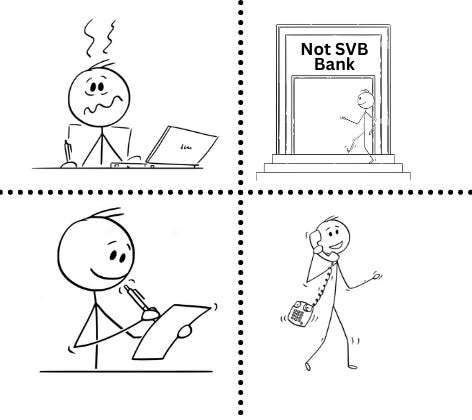
Usually the private market of venture capital does not often result in headline events but the closure of Silicon Valley Bank (SVB) this past week caused waves throughout the community. SVB was a leading provider of commercial banking services to the venture capital community including almost 50% of the tech and life science start-ups.
Thankfully for bank customers the FDIC was able to protect all deposits, although investors in SVB are not expected to have much if any recovery. Some could argue the actions by the FDIC are an implicit guarantee of bank deposits above the current $250,000 level but to date the official statements stop short of explicit language.
The ripple effect across the start-up ecosystem caused many companies to revisit their banking relationships and treasury management procedures. Each company is unique so any advice or suggestions we share are for discussion purposes only.
When we help advise companies on treasury management practices, we often suggest having at least two banks with commercial checking accounts. Opening a second account at a different bank should not require a detailed setup as most banks wave fees for a minimal deposit in basic corporate accounts. For example, we have a commercial checking account at a large bank which waves all fees for maintaining an average monthly balance of $2,000. It’s a low cost way to reduce treasury risk and provides optionality and cash diversification. We have years of CFO and corporate finance experience so reach out to us directly and let’s have a conversation.
The uncertainty after the SVB failure prompted many companies to ask existing or potential investors for advice or short term funding options. During a time of crisis, these discussions are more difficult if companies have not maintained an ongoing relationship with existing or potential investors. The SVB saga is a reminder of why all companies should have a strategy for consistent investor updates or interactions.
Investor or Network Updates
Providing investor updates on a monthly basis may not sound like the most exciting project but consider it a combination of marketing, investor engagement, and teambuilding. The majority of company updates we receive are in bullet point format and most tend to be just one page.
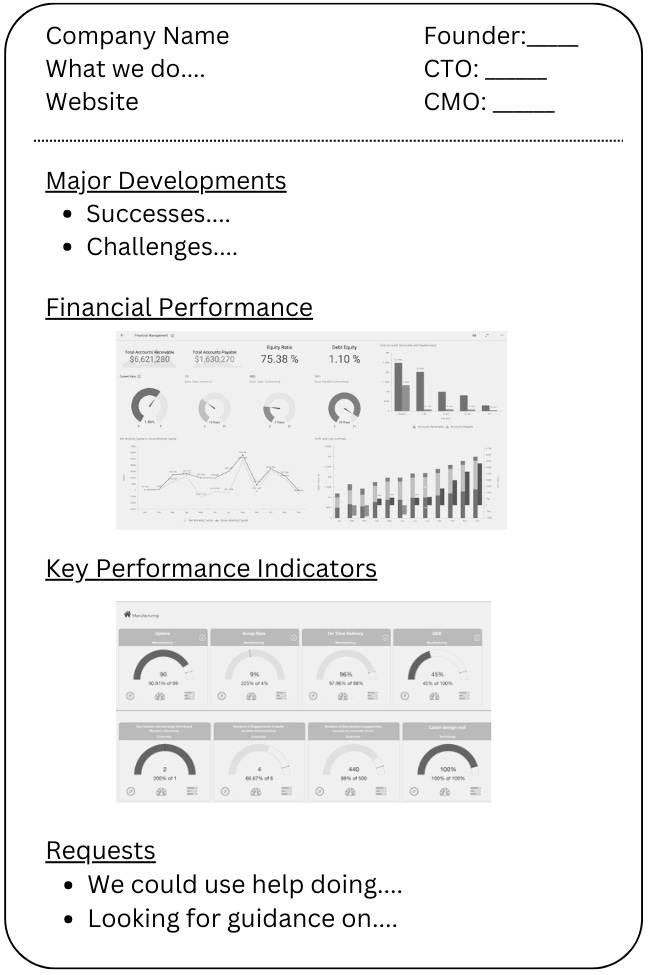
Most marketing discussions suggest starting with a description of the product, so begin with a brief overview of the company including a sentence of what the company does, its website, and names of the top few executives. The next four sections are used to provide readers a broad picture of the company and its operations without going into specific details.
🏭 Major Developments - successes and challenges from the prior month.
Successes – positive events from the month such as a new hire, client win, or team events.
Challenges – maybe a lost customer, failed product test, or delayed marketing program. Include a one sentence description of lessons learned or initial changes made to overcome the challenge.
💰 Financial Performance – high level metrics, not be a detailed financial analysis. Common metrics include cash burn and runway, monthly revenue and expenses, or customer acquisition costs. Consider a short description for any material changes.
📊 Key Performance Indicators – the top 3-5 KPI’s such as revenue per customer, number of new clients, or unit sales.
🙋♂️ Requests for Help or Guidance - a call to action for readers by indicating where they may provide guidance or support. It could be a request for introductions to new marketing firms, guidance on building employee benefits, or suggestions for helpful conferences.
Be careful about message creep as these updates should be brief. Do not start reducing the font size to include more words (we have seen more than one company do this). Revisit the format every few months and cut out metrics or sections which are no longer helpful. After the first few months, target no more than an hour to generate each update.
Some of those most impacted by the future investment return of the company are its employees, so consider sharing the monthly update with the entire team. Providing everyone with the same level of detail builds team cohesion, prompts internal idea generation, and allows the team to understand the successes and challenges together.
Additional Thoughts
The SBV failure reminds companies of any size why it’s important to maintain constant communication with investors and advisors. As we write this the market volatility around the banking industry continues, serving as a reminder to review treasury and banking procedures as access to cash is foundational to businesses of any size.
Wishing everyone a great weekend,
-The Caymont Ventures Team.