

Happy Thursday, 👋
Investors and founders believe their companies have exponential growth opportunities, yet rapid expansion may not always be the most advisable pathway. Presentations often feature the iconic hockey stick growth chart, forecasting rapid revenue increases over a brief period. While such projections are impressive, they raise several concerns when evaluating companies with such ambitious growth expectations.
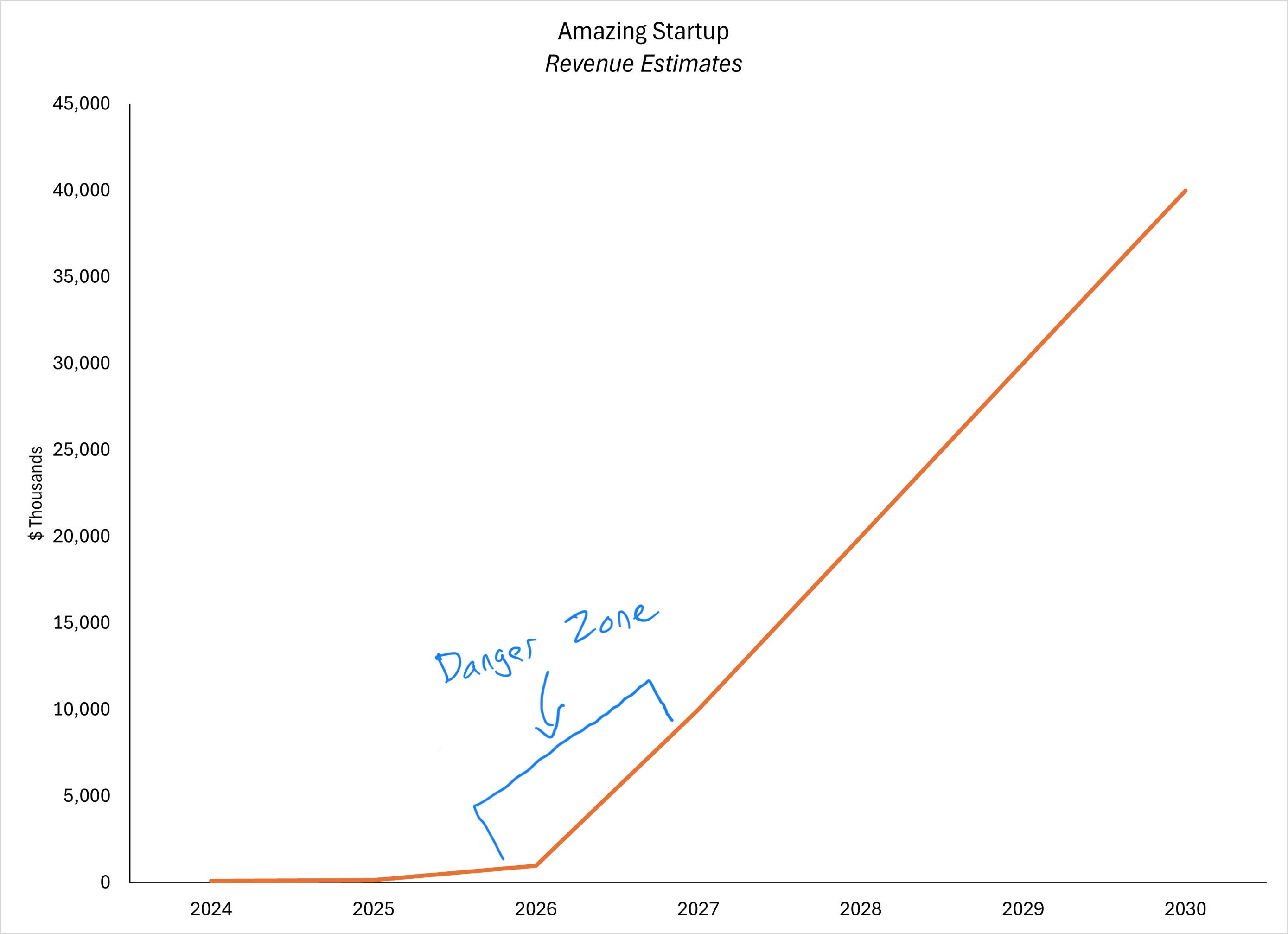
The Pitfalls of Rapid Growth
The primary danger of rapid growth lies in its potential to exceed a team's capabilities. In the short term, managing exponential growth might be feasible, but without robust policies and procedures, rapid expansion can overwhelm the team, increasing the likelihood of failure. Many teams rush to capture market share, planning to address operational or foundational issues later. This strategy seldom succeeds as growth demands significant changes in operations, personnel, and internal systems.
Examples of growth challenges include the following:
🚲 Peloton experienced a surge to a market value of nearly $50 billion during the pandemic. However, hasty decisions to overspend on acquisitions and logistics backfired as record demand growth was not sustainable. As the effects of the pandemic on product demand declined, so did the company’s valuation.
🐄 Zynga, known for games like Farmville and Cityville, went public in 2012 at $10 per share but faced prolonged struggles with meeting growth targets, resulting in the company taking more than a decade for its stock to rebound above its IPO price. The overemphasis on growth instead of building a sustainable business foundation was eventually acknowledged by its CEO.
🎬 Quibi, launched in April 2020 with almost $2 billion in funding, closed by December 2020. Despite high user growth forecasts and substantial spending, it achieved only 25% of its projected user base. A more conservative growth plan might have prolonged its operational lifespan and saved a lot of investor capital.
Foundational Growth Strategies
Our discussions with founders often emphasize the importance of growing at a pace that aligns with the internal capabilities of the company. Exceeding these capabilities might work temporarily, but the absence of adequate infrastructure inevitably catches up. We get concerned when hearing leadership teams using rapid growth to justify delayed upgrades to systems and procedures, as it signals a potential mismatch between the short and long term strategies.
For founders, understanding what drives their company's growth is crucial. If they cannot articulate clear reasons for growth or rely on temporary external factors, it raises questions about the sustainability of their expansion plans. The case of Peloton illustrates how pandemic-driven demand masked the challenges of a long-term shift in consumer preferences. Asking founders about their growth drivers provides us additional insight into how they approach strategic planning.
Sustainable Growth Approaches
Initial growth phases are exhilarating, but sustainable expansion requires a methodical leadership approach. We guide founders to balance scaling with the implementation of systems and procedures while also upskilling their teams. As companies grow, the need for different skill sets emerges, and employees who were suitable at inception may no longer have the skill set necessary to continue supporting the team during later stages of growth.
When evaluating companies with exponential growth projections, we consider several factors:
The effectiveness of systems to transition and onboard necessary talent.
The existence of mechanisms to track departmental performance and identify areas needing focus.
Plans for scalable financial systems that can grow with the company.
The current leadership's capability to steer future growth and their succession plans.
Our experience with early-stage companies has taught us that even the best prepared can face challenges from inadequate systems or procedures. Bad financial decisions can be masked by rapidly increasing revenues, leading to complacency and overspending. Acquisition talks often falter when potential buyers discover the target cannot produce basic financials or a quality earnings report. Leadership and teams must recognize their skill limits and be willing to make necessary changes for sustained growth.
Additional Thoughts
Adequate growth can propel a company forward, but without a solid foundation, it may steer towards failure. Investors should ask the right questions, and management teams must understand what is needed for ongoing success. Exponential growth forecasts are beneficial only if they are part of a broader plan to enhance the company’s overall infrastructure.
Wishing everyone a great weekend,
-The Caymont Ventures Team.