
Happy Thursday, 👋
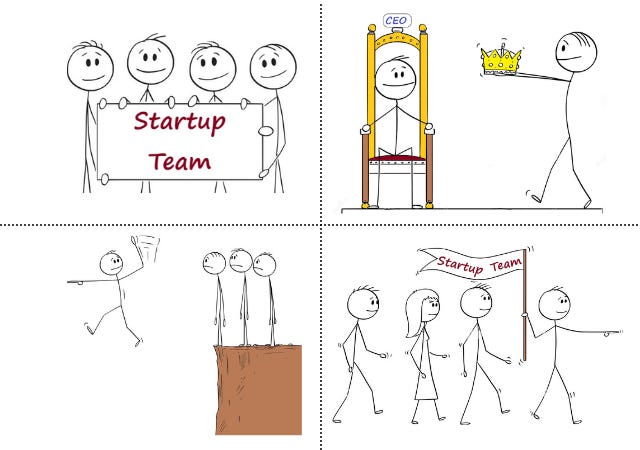
As startups grow, there comes a point where not everyone can be the main voice of the company. What begins as a small group working through ideas together eventually requires structure. With that structure comes titles. The process can feel administrative, but it becomes unavoidable once a startup moves from being an experiment to becoming a real business.
Titles are among the most powerful forces inside an organization. They shape behavior, influence communication, and quietly redefine relationships. Of all the titles a company assigns, none tends to have a more dramatic impact than Chief Executive Officer.
When the decision is made to appoint a CEO, the internal dynamics of the company begin to change. How people speak, what information moves upward, and how disagreement is expressed all start to shift. What makes this transition difficult to recognize is that it rarely comes with a visible moment. There is no single meeting or announcement that causes it. Instead, it emerges as a natural psychological response to hierarchy.
Appointing the first CEO should therefore be a deliberate decision, not one made by default. Those three letters can influence the future direction of the company by creating subtle but meaningful changes throughout the organization.
Why Titles Change Behavior
Behavioral change following a shift in title is well documented. Social Identity Theory explains how people rapidly adjust behavior based on perceived roles and group status. A title does not simply describe responsibility. It signals rank.
Once someone is given the CEO title, expectations change. Authority is assumed. Even if the individual behaves exactly as before, others begin to interact differently.
This is why founders often say, “I did not change, but everything around me did.” Research suggests they are correct. It is the title that causes those around them to modify their perceptions and behavior. Conversations become more cautious. Feedback becomes more polished. casual opinions and early product concerns are softened or delayed.
This is not a failure of character. It is a predictable human response to shifting power dynamics, and it often surprises first-time executives who underestimate how quickly it happens.
Power Distance and the Cost of Information
As perceived distance increases between people on an organizational chart, information quality tends to decrease. Bad news travels more slowly. context gets filtered. People begin optimizing for safety rather than accuracy as organizational distance increases.
This dynamic matters most in startups. Early-stage companies depend on fast feedback loops and honest conversations. For a time, information flows freely because everyone is close to the work and to each other.
As structure forms, that closeness fades. Hierarchy introduces distance between decision-makers and the information they rely on. The very structure designed to help the company scale can begin to interfere with learning if it is not managed carefully.
Leadership Expectations Solidify
Founders are often given significant leeway early on. Roles are fluid. Responsibilities shift based on skill sets and immediate needs. Few startups launch with a clearly defined organizational structure.
Over time, however, the company must present a coherent external narrative. Investors, customers, partners, and new employees look for a clear voice. They want to know who is accountable for strategy, execution, success, and failure.
Internally, expectations solidify as well. Once a CEO is named, their suggestions begin to sound like directives. Their ideas can be interpreted as decisions. What was once an open discussion may now feel like a settled path forward.
This change is rarely intentional. It emerges because leadership titles carry implicit authority, whether the person holding the title intends to exercise it.
Someone Has To Be CEO
For a business to succeed, there must ultimately be a final decision-maker. Someone does have to be CEO.
The CEO title becomes necessary when the cost of ambiguity exceeds the cost of hierarchy. That inflection point usually arrives as external complexity grows. Investors, customers, regulators, and partners need clarity. The title solves an external coordination problem, even as it introduces internal friction.
The mistake many founders make is assuming the CEO title is a neutral formality. It is not. It is a structural intervention.
Founder Does Not Always Equal CEO
This tension becomes more pronounced when founders assume that founding and leading are interchangeable skills.
Founding a company is an act of creation. It requires curiosity, experimentation, and comfort with ambiguity. Being CEO is an act of orchestration. It requires managing hierarchy, preserving information flow, and ensuring authority does not distort reality.
These skill sets overlap, but they are not identical. Some founders excel at both. Many do not. Launching and leading a company are two very different skill sets.
The greater risk is not that an unprepared founder becomes CEO. It is that the company never asks whether the person in the role is well suited to manage hierarchy. This is often where advisory boards and mentors play a critical role, helping founders evaluate the needs of the business rather than defaulting to titles.
Some highly successful founders never became CEO because they recognized their strengths were creative or technical rather than organizational. Others stepped aside early so someone better equipped to manage scale could lead.
Conversely, founders who successfully grew into the CEO role almost always did so with help. Strong mentors, engaged boards, and advisors outside the company’s internal politics provided guidance, perspective, and honest feedback. The transition succeeded not because leadership came naturally, but because it was treated as a discipline to be learned.
Final Thoughts
The CEO title is not just a nameplate. It is a structural decision that reshapes how truth moves inside a company.
Every company will eventually need a CEO. Not every founder should automatically assume that role. Some of the most successful founders recognized early that creation and orchestration are different jobs and made deliberate choices accordingly.
For founders who do step into the CEO position, long-term success often depends on surrounding themselves with strong advisors who sit outside the internal hierarchy. These voices help counteract the natural distortions that come with authority and preserve the flow of honest information.
For advisors, investors, and boards, the takeaway is equally important. The CEO decision is not a reward for past effort. It is an operating choice that shapes how a company learns, adapts, and scales.
The most durable companies are built by founders who treat the CEO title as an operating decision, not a symbol, and choose the person best able to preserve clarity, candor, and trust as the company scales.
Wishing everyone a great weekend,
-Eric.