
Happy Thursday, 👋
Less than a month into the new year makes it a great time to talk about quitting. The idea of quitting often has a negative connotation in part because social media posts tend to focus on celebrating success while we rarely hear about business failures.
Why Quitting Is Difficult
In theory quitting a project or closing a business should be easy as you just stop. The mental challenge is more difficult as entrepreneurs constantly weigh their options and look for signs success may be around the next corner.
Some of the best quitters are professional poker players as over 75% of the time they decide to fold a hand before placing the first bet. Amateur players fold only half the time as survivorship bias clouds their judgement as they operate on hope instead of facts. Quitting fast and often allows professional players to retain their chips for the highest probability hands.
Deciding To Quit
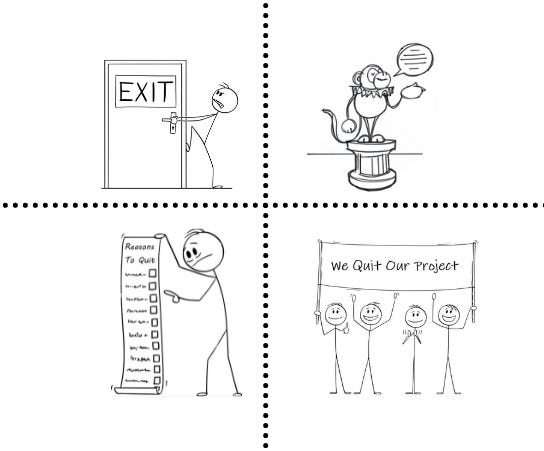
Quitting is a difficult decision, so we often suggest management teams think about monkeys.
Imagine deciding to train a money to stand on a pedestal and recite Shakespeare. Most teams will start building the pedestal because it is easier and demonstrates immediate progress. Investors notice a well-built pedestal and invest additional capital anticipating the company is close to its goal of having a Shakespearian monkey. After a large capital raise, the team spends months of 100 hours weeks reading Shakespeare to the monkey, trying to teach it to recite even a single word with no luck. The eventual failure of the company may have been prevented if the team took time to evaluate the viability of each step in the process.
Before developing a new product or starting a new business, write out each step and find the most difficult point, the one where the team has to start training a monkey to recite prose. Discussing potentially insurmountable obstacles and deciding to quit fast allows the team to save time and investor capital to refocus on other ideas.
Sometimes the monkey is not clearly defined and instead smaller challenges compound over time to prevent achieving success. Developing a Quit List outlining the reasons to pause a process removes emotions and prevents survivor bias from clouding decisions. Mountain climbers often use a similar process to outline the reasons for turning back from a climb, removing the potential for emotions to impact decisions despite being close to reaching a summit.
Quitting
Instead of using the term quitting or terminating a project or idea, consider rephrasing the discussion and relabeling it as putting an idea on hold or pausing the process. The different terminology conveys a message to the team the time and effort invested may still have value and all effort is not lost.
Quitting is never an easy decision but may be one of the best decisions a company can make. Board members and investors tend to be removed from the daily struggles of a company so often have the most influence in helping teams realize when it may be time to change directions. Finding the monkey in a project or outlining a Quit List helps teams reduce the impact of survivor bias and build a culture where quitting becomes an acceptable outcome.
Wishing everyone a great weekend.
-The Caymont Ventures Team.