

Happy Thursday, 👋
Start-up teams often comprise highly confident individuals. Being part of such teams tends to foster an increase in overall confidence, especially during self-assessments. Founding teams often view a company’s valuation as a form of self-assessment or reflection on their work, making it an area of intense debate and discussion during early-stage capital raises.
Early-Stage Value Discussions
Raising capital involves valuing the company to guide investors in pricing their investment. The values of public companies are traditionally set using metrics such as discounted cash flows, financial multiples, or net asset valuations. The valuation of an early-stage private company may incorporate some of these metrics but more often involves a qualitative approach.
Valuations at the Seed Stage rarely reflect a company’s future earnings potential as there is only limited historical data to build a reliable revenue forecast. Teams often include exponential growth forecasts in their presentations and often default to setting a valuation based on achieving these metrics. However, it is rare for an early-stage company to deliver on its growth projections as actual revenue numbers are often a fraction of expectations due to unforeseen challenges with launching a new venture.
Estimating a Value
Perception and belief in a team’s ability to achieve its goals greatly influences early-stage valuation. The following qualitative factors often prove helpful in supplementing the decision process:
🏃♀️🏃♂️ Comparable Companies: This does not involve financial comparability, but rather progress comparisons to similar companies in the industry. We can often gather enough data to understand where a company ranks within an industry and use the information as part of the value estimation. The process is akin to viewing a snapshot of competitors mid-race and using that moment to infer who may have the best chance of winning.
🧸🏭 Product or Company: Most early-stage companies initially focus on building a single product or solution to a problem. Valuations are adjusted based on whether investors perceive the company as building a product capable of acquisition or developing a team able to scale a product into a company.
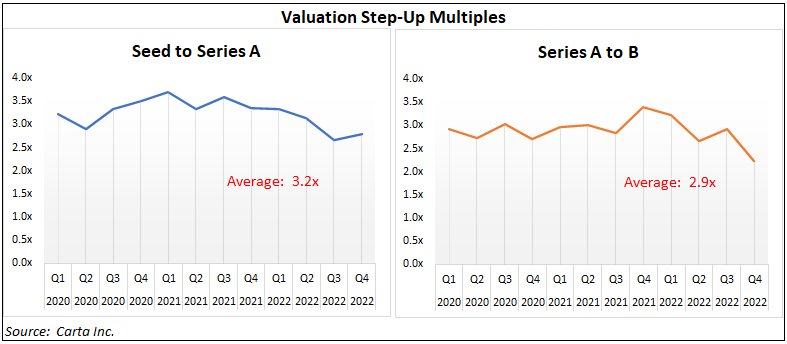
📈💰 Future Fundraising: Aiming for a high valuation as part of an initial capital raise often complicates future raises. The average step-up valuation from Seed through Series B is 2-3x. Therefore, a company valued at $5 million for its Seed Round should aim for a Series A raise at $15 million and a Series B at $45 million. Starting a Seed Round with a high valuation increases the pressure on the company to deliver more significant revenue growth to succeed in raising subsequent rounds of capital.
Additional Thoughts
Founders often strive for a high initial valuation at the Seed Stage, propelled by a clear vision of building a successful company. However, investors focus on how future rounds of capital will perceive the initial valuation. Finding a compromise between these two perspectives often involves leaning more on qualitative factors rather than solely relying on financial forecasts in the early stages of a company's life.
While confidence is integral to launching a company, a conservative outlook often proves to be a more successful long-term strategy when deciding on the initial Seed Stage valuation.
Wishing everyone a great weekend,
-The Caymont Ventures Team.