

Happy Thursday, 👋
We often discuss our interactions with early-stage companies from the perspective of a venture capital fund, but this week are taking a different perspective to these early-stage ideas. Recently, we have received several questions about how venture capital differs from the public stock market. While the media frequently covers news about public company values and stock trading, it's important to note that there are nearly three times as many companies within the venture capital space.
Even if you're not actively investing in a venture fund or making angel investments, understanding how the venture market differs from the public stock markets can be beneficial. Although the venture capital marketplace lacks an opening or closing bell, it remains a powerful force in the economy. In fact, out of every 100 US publicly traded companies founded since the 1970s, half were initially funded by early-stage venture investors.
Venture Capital vs. Public Markets
An initial difference between the markets is the media's focus on public stock markets due to the constant flow of actionable news items. The Dow or S&P indexes move throughout the day, companies issue press releases, and traders discuss investments. In contrast, venture capital markets may seem less dynamic since investments do not have minute-to-minute valuation changes or analysts predicting quarterly earnings numbers.
The average stock is held for 5-10 months, with the average mutual fund buying and selling 50% of its portfolio within a year. These numbers explain why public markets receive so much attention, as billions of shares trade daily. Across venture capital, the holding period is instead measured in years as companies are in the development stages and building initial market share.
Despite the longer holding period, venture capital investors have historically been rewarded for their patience. Over the past five years, venture investments have returned 7% more than the public market (NASDAQ) and over ten years, they have beaten the index by 2% on average. Additionally, venture investors are often active in further driving returns by working with company leadership on strategy, making customer introductions, or guiding acquisition discussions.
One of the key differentiators for venture capital is the ability to help build the foundation of a company or industry. Venture investments are often the first significant investments in a company, allowing teams to turn ideas into businesses. In contrast, public companies receive capital only during an initial stock offering, with the billions traded daily merely representing money moving between third-party investors.
Shifting Public Markets
Opportunities in the venture capital space are much broader than in public markets due to the number and size of companies. Since 1996, the number of public companies has declined by 43% to about 4,000 today. In comparison, the venture capital market encompasses nearly three times as many companies, providing a wider range of opportunities for investors
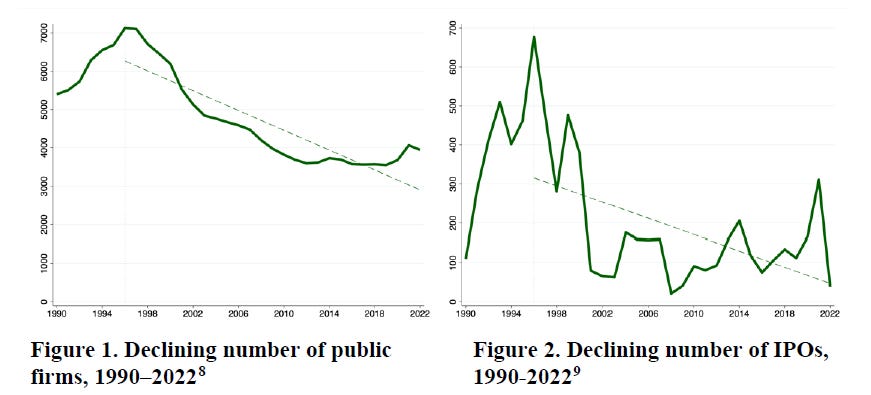
Although there are fewer public companies today, their combined value continues to grow. The current market capitalization of all US publicly traded companies is about $50 trillion, almost double the US GDP. Thirty years ago, this metric was reversed, with US GDP nearly twice the value of all public companies. Notably, the largest 20 public companies account for just over 40% of the total public market value, further shrinking the overall market.
Additional Thoughts
Building a startup can be a lonely journey, especially when most economic excitement focuses on public companies. Public markets are crucial as they provide liquid investments, but they often become a proxy for the broader economy. It helps to remember that beyond the 4,000 public companies are several thousand more founders and startup teams quietly building the future foundation of our economy.
Wishing everyone a great weekend,
-The Caymont Ventures Team.